Tag Archives: tuberosa – tuberose

Fueguia 1833 El Otro Tigre – Soñando una fiera

imagen: Artsconnected.org          artista: Evert van Muyden         “Two Tigers”

Me encontraba al acecho del perfume más animal que pudiera encontrar;  si traspasaba la línea del Fauvismo, mejor aún.  Mi propósito era superponerlo con ciertos soliflorales a fin de tornarlos sucios, viciados, no tan virginales.

Casi segura de que sería el lugar donde hallar a mi fiera, me encaminé a la boutique de Fueguia 1833 . Una vez ahí, mi curiosidad giró alrededor de El Otro Tigre, un perfume  bautizado en honor al poema de Jorge Luis Borges que puede leerse más abajo. 

La amable vendedora me advirtió acerca de su carácter fuerte y masculino, pero generalmente hago caso omiso de las divisiones de género (y, para ser honesta, de la mayor parte de los consejos) cuando de perfumes se trata. No encontré la fragancia particularmente masculina; tampoco femenina, para el caso. Ni femme, ni homme: este líquido era bestial y peligroso. 

La salida, agresiva y punzante con ambrette, es de una cualidad indecente que remite al olor de los felinos grandes.  Muscone and muscenone -compuestos sintéticos que sustituyen el almizcle natural-  juegan un papel clave emulando el poder de atracción sexual de esta secreción  (por razones de índole ética el uso del almizcle natural está practicamente desterrado). Luego de unos momentos, la fragancia se torna más suave y vibrante con la irrupción de una nota de tuberosa. Esta tuberosa no es abiertamente floral  sino que prefiere exaltar su aspecto alcanforado. La adición de oud lleva al extremo el aspecto salvaje de la mezcla.

A pesar de su intensa animalidad, El Otro Tigre retiene cierta frescura que aparece, desaparece y arroja luces sobre una composición sombría, pintando un retrato del tigre y el follaje a su alrededor.  El  sándalo y la  vainilla de Madagascar  doman a la fiera y tornan la base cálida y dulzona. Ahora el animal es dócil, apenas un reflejo del tigre sediento de sangre que encontré en un principio.

Relativamente compacto en estructura, El Otro Tigre se superpone maravillosamente bien con el bouquet de rosas de Fueguia 1833 Juan Manuel. Combinado con el suave y dulce Ballena de la Pampa, es un sueño almizclado. 

Prefiero el extrait para superponer con otros perfumes y el absolu –aplicado ligerísimamente- si voy a disfrutarlo solo. Esta esencia, poderosa en todas sus encarnaciones, funciona mejor en cantidades muy moderadas.

Caro

Origen de la muestra: botellas compradas en Fueguia 1833, Buenos Aires

El Otro Tigre

Pienso en un tigre. La penumbra exalta
la vasta Biblioteca laboriosa
y parece alejar los anaqueles;
fuerte, inocente, ensangrentado y nuevo,
él irá por su selva y su mañana
y marcará su rastro en la limosa
margen de un río cuyo nombre ignora
(en su mundo no hay nombres ni pasado
ni porvenir, sólo un instante cierto.)
Y salvará las bárbaras distancias
y husmeará en el trenzado laberinto
de los olores el olor del alba
y el olor deleitable del venado.
Entre las rayas del bambú descifro
sus rayas y presiento la osatura
bajo la piel espléndida que vibra.
En vano se interponen los convexos
mares y los desiertos del planeta;
desde esta casa de un remoto puerto
de América del Sur, te sigo y sueño,
oh tigre de las márgenes del Ganges.


Cunde la tarde en mi alma y reflexiono
que el tigre vocativo de mi verso
es un tigre de símbolos y sombras,
una serie de tropos literarios
y de memorias de la enciclopedia
y no el tigre fatal, la aciaga joya
que, bajo el sol o la diversa luna,
va cumpliendo en Sumatra o en Bengala
su rutina de amor, de ocio y de muerte.
Al tigre de los símbolos he opuesto
el verdadero, el de caliente sangre,
el que diezma la tribu de los búfalos
y hoy, 3 de agosto del 59,
alarga en la pradera una pausada
sombra, pero ya el hecho de nombrarlo
y de conjeturar su circunstancia
lo hace ficción del arte y no criatura
viviente de las que andan por la tierra.

Un tercer tigre buscaremos. Éste
será como los otros una forma de mi sueño, 
un sistema de palabras
humanas y no el tigre vertebrado
que, más allá de las mitologías,
pisa la tierra. Bien lo sé, pero algo
me impone esta aventura indefinida,
insensata y antigua, y persevero
en buscar por el tiempo de la tarde
el otro tigre, el que no está en el verso.

Jorge Luis Borges, 1960

foto: gentileza de Fueguia 1833

Fueguia 1833 El Otro Tigre – Dreaming of a wild beast

I was to be on the prowl for the most animalic fragrance  I could find; if it ventured to cross the threshold of Fauvism, all the better.  My aim was to layer it with certain soliflores in order to turn them dirtier, tainted, not so virginal.

Almost sure it would be the right place to find my beast, I headed straight to the Fueguia 1833 boutique. Once there, my curiosity was piqued by El Otro Tigre, a perfume  named after the poem by Jorge Luis Borges which can be read below. 

A charming sales assistant warned me about its strong and masculine character but I generally disregard gender divisions (and, to be honest, most advice) when it comes to scents. I didn’t find the fragrance particularly masculine, or feminine for that matter. No femme, no homme: this juice was animalic and dangerous. 

The opening, aggressive and pungent with ambrette is almost indecent, redolent of the smell of big cats.  Muscone and muscenone -synthetic compounds that substitute natural musk –  play a key role mimicking the sexual attractant power of this secretion (natural musk has practically been banned due ethical motives).  After a few moments, the fragrance gets softer and brighter as a tuberose note emerges. This tuberose isn’t  overtly floral but chooses to exalt its green camphoraceous aspect instead. The addition of oud takes the wild aspect of the blend to the extreme.

Despite its intense animality, El Otro Tigre retains a certain  freshness which wafts now and then, casting lights on the shadowy composition, painting  a  portrait of the tiger and the foliage around him.  Sandalwood and Madagascan vanilla tame the beast and make the drydown surprisingly warm and sweetish. This animal is now docile, only a reflection of the bloodthirsty tiger I first met.

Relatively compact in structure, El Otro Tigre layers wonderfully well with the rose bouquet of Fueguia 1833 Juan Manuel. Combined with the softer and sweeter Ballena de la Pampa, it becomes pure musk heaven. 

I prefer to wear the extrait when I layer it with other fragrances and the absolu –applied with the lightest hand- if I want to enjoy it on its own. This essence,  powerful in all concentrations, works best in very moderate quantities.

Caro

Origin of sample: Bottles purchased at Fueguia 1833, Buenos Aires

The Other Tiger

A tiger comes to mind. The twilight here
Exalts the vast and busy Library
And seems to set the bookshelves back in gloom;
Innocent, ruthless, bloodstained, sleek
It wanders through its forest and its day
Printing a track along the muddy banks
Of sluggish streams whose names it does not know
(In its world there are no names or past
Or time to come, only the vivid now)
And makes its way across wild distances
Sniffing the braided labyrinth of smells
And in the wind picking the smell of dawn
And tantalizing scent of grazing deer;
Among the bamboo’s slanting stripes I glimpse
The tiger’s stripes and sense the bony frame
Under the splendid, quivering cover of skin.
Curving oceans and the planet’s wastes keep us
Apart in vain; from here in a house far off
In South America I dream of you,
Track you, O tiger of the Ganges’ banks.

It strikes me now as evening fills my soul
That the tiger addressed in my poem
Is a shadowy beast, a tiger of symbols
And scraps picked up at random out of books,
A string of labored tropes that have no life,
And not the fated tiger, the deadly jewel
That under sun or stars or changing moon
Goes on in Bengal or Sumatra fulfilling
Its rounds of love and indolence and death.
To the tiger of symbols I hold opposed
The one that’s real, the one whose blood runs hot
As it cuts down a herd of buffaloes,
And that today, this August third, nineteen
Fifty-nine, throws its shadow on the grass;
But by the act of giving it a name,
By trying to fix the limits of its world,
It becomes a fiction not a living beast,
Not a tiger out roaming the wilds of earth.

We’ll hunt for a third tiger now, but like
The others this one too will be a form
Of what I dream, a structure of words, and not
The flesh and one tiger that beyond all myths
Paces the earth. I know these things quite well,
Yet nonetheless some force keeps driving me
In this vague, unreasonable, and ancient quest,
And I go on pursuing through the hours
Another tiger, the beast not found in verse.

Jorge Luis Borges, 1960

Translation taken from www.poemhunter.com

Amouage Honour Woman – Alas de mariposa

imagen: Art.com

No es un secreto para quienes me conocen que  Amouage se cuenta dentro de mis casas favoritas: una inteligente dirección creativa, varios de los mejores narices del mundo y materias primas de primera calidad dan como resultado exquisitos perfumes de gran complejidad, proyección y longevidad.

Honour Woman fue lanzado en junio de 2011. Este floral blanco -inspirado por Mme. Butterfly, de Puccini– fue compuesto por Alexandra Carlin y Violaine Collas bajo la dirección creativa de Christopher Chong.

Los florales blancos pueden ser enormes, desmesurados y a veces…bueno…demasiado florales. He tenido pesadillas en las que tuberosas carnívoras y gardenias monstruosas me perseguían incansablemente para devorarme, así que tiendo a desconfiar un poco de esta familia.

Me aproximé cautelosamente a Honour Woman y sentí alivio al ser saludada por una apertura ligeramente verde, con una pizca de pimienta, acidulada por el ruibarbo y un poco fría. El corazón es un radiante bouquet de flores blancas –gardenia, jazmín, tuberosa y delicado lirio del valle – que logra mantener algo de verdor y humedad de rocío. Este bouquet es luego envuelto por una niebla resinosa de incienso, ámbar y opopanax. El fondo es suave, cálido y seco. Es en este punto donde la fragancia pierde su inocencia previa.

Aunque quizás esta fragancia no  les siente a los minimalistas, apuesto a que tendrá aún más seguidores que los pesos pesados de Amouage: Gold y Jubilation 25.

A pesar de su opulencia y complejidad, Honour  Woman es sorprendentemente aireado para un Amouage y conserva un aura de fragilidad. Creo que sería un perfume fabuloso para una novia.

Caro

Origen de la muestra: muestra cortesía de Amouage

foto: Amouage.com

Amouage Honour Woman – Butterfly wings

It is no secret to those who know me that Amouage is among my favorite houses: smart creative direction, many of the world’s best noses and top quality raw materials give as a result exquisite fragrances of great complexity, projection and longevity.

Honour Woman was launched in June 2011. This white floral -inspired by Puccini’s Mme. Butterfly- was composed by noses Alexandra Carlin and Violaine Collas under the creative direction of Christopher Chong.

White florals can be huge, overpowering and sometimes just…well…just too floral. I have had nightmares in which I was relentlessly chased by carnivorous tuberoses and monster gardenias that intended to devour me, so I tend to be a bit wary of that family.

I approached Honour Woman with caution and was relieved to be greeted by a greenish and peppery opening, tart with rhubarb and somewhat chilly. The heart is a radiant bouquet of white flowers –gardenia, jasmine, tuberose and delicate lily of the valley – that manages to retain a slight dewy greenness. That bouquet is later wrapped in a resinous haze of frankincense, amber and opopanax. This drydown is smooth, warm and dry. It is here where the scent loses much of its previous innocence.

Although this fragrance will most likely not suit minimalists, I’d bet it will appeal to a much wider audience than the Amouage heavyweights: Gold and Jubilation 25.

Despite its opulence and complexity, Honour Woman is surprisingly airy for an Amouage and keeps a certain aura of fragility. I think it would make a fabulous bridal perfume.

Caro

Origin of sample: sample courtesy of Amouage

Eau d’Italie Magnolia Romana – La fuerza de la fragilidad

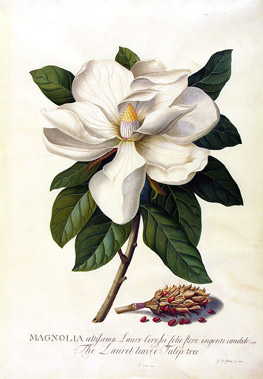
imagen: Vam.ac.uk     Georg Dionysius Ehret, 1743

Si tuviera que enumerar los árboles más bellos que adornan nuestra Buenos Aires; junto con el jacarandá y el palo borracho, la magnolia seguramente tendría un lugar de preferencia. Sus raíces serpentinas, tronco corpulento y hojas oscuras se ven hermoseados por flores grandes y robustas que esconden un aroma delicado y elusivo.

Hace mucho mucho tiempo emprendí la búsqueda de un verdadero perfume de magnolia, uno que capturara la fragancia real de la flor: quería que mi magnolia fuera alimonada, crujiente, ligeramente amarga; soleada y sombría a la vez, pero -¡Ay!- sólo logré toparme con  impostores jazmines, gardenias y tuberosas. Desilusionada, abandoné mi esfuerzo vano y busqué consuelo en los brazos de ámbares especiados y rosas oscuras.

Los años siguientes me encontraron evitando los florales ligeros como si fueran la peste misma. Hasta el día en que tropecé con Magnolia Romana.

Creada por Bertrand Duchaufour para Eau d’Italie, esta agua de toilette resulta una sutil obra maestra que susurra en vez de gritar. La fortaleza mayor de Magnolia Romana reside en su aparente fragilidad. De la misma manera en que el sutil aroma de la magnolia viene en la naturaleza acompañado por un árbol robusto, esta eau de toilette es respaldada por una sólida composición donde nada es demasiado literal: el limón no se presenta bajo la forma de jugo y lo limpio retiene una pizca de suciedad.

La salida atrapa la atención: fresca y picante, con reminiscencias de hojas de limón y albahaca morada. Casi inmediatamente, una magnolia a la que llamaría acuosa más que acuática se torna corpórea gracias a la adición de nuez moscada y una insinuación de tuberosa.  Luego trueca algo de su transparencia por la tibieza de las notas de heno y un suave almizcle blanco; un almizcle que encuentro consistentemente en casi toda la línea Eau d’Italie.

Magnolia Romana mantiene un sutil verdor a lo largo de toda su evolución y nunca se vuelve demasiado dulce. No proyecta muy lejos, eligiendo ser un íntimo parfum de peau con una longevidad sorprendente.

Caro

Origen de la muestra: muestra gentileza de Eau d’Italie

foto: Eauditalie.com

Eau d’Italie Magnolia Romana – The strength of fragility

If I were to name the most beautiful trees that grace our Buenos Aires;  alongside jacarandá and palo borracho,  magnolia would definitely have a preferential place. Its serpentine roots, robust trunk and dark leaves are beautified by big sturdy flowers that hide a delicate and elusive scent.

Long long ago, I searched for a true magnolia fragrance, one that managed to capture the true scent of the flower: I wanted my magnolia to be lemony, crisp, sligthly bitter; sunny and shady at a time but, alas, I only suceeded in meeting jasmine, gardenia and  tuberose imposters. Disappointed, I abandoned my futile effort and threw myself in the consoling arms of spicy ambers and dark roses.

The following years found me avoiding soft florals like the plague. That is until the day I stumbled upon Magnolia Romana.

Created by Bertrand Duchaufour for Eau d’Italie, this eau de toilette happens to be an understated masterpiece, one that whispers instead of shouting. Magnolia Romana’s strongest asset is its apparent fragility. In the same way the subtle scent of magnolia is -in nature- accompanied by such a robust tree, this seemingly shy and inoffensive eau de toilette is backed up by a balanced composition where nothing is too literal: lemony doesn’t translate as lemon juice and cleanliness retains a bit of dirt.

The opening is attention-grabbing: fresh and spicy, redolent of lemon leaves and purple basil.  Almost immediately, a magnolia note I would call watery rather than aquatic becomes more corporeal thanks to the addition of nutmeg and the slightest hint of tuberose.  It later trades some  transparency for the warmer notes of hay and soft white musk; a musk I consistenly find in most of the Eau d’Italie line.

Magnolia Romana never becomes too sweet and  retains a subtle verdancy throughout its evolution. It never projects too far, choosing instead to be an intimate parfum de peau with  surprisingly good longevity.

Caro

Origin of sample: sample courtesy of Eau d’Italie

Creed Fleurissimo – Apto para princesas

foto: Schweizer-illustrierte.ch

Inspirarse en un ramo de novia conlleva algo más que evocar a cómo huele. Es pensar en el momento exacto de dar el sí, en los preparativos y en lo que sigue inmediatamente después: la noche de bodas.

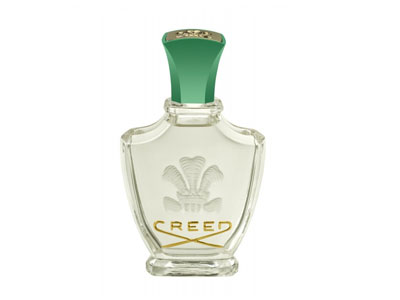
Creed imaginó en Fleurissimo a una novia tan carnal como etérea. Se dice que el perfume fue encargado por Rainiero de Mónaco en ocasión de su boda con Grace Kelly, lo cierto es que la fragancia encarna a la perfección la belleza y elegancia de la actriz norteamericana devenida en princesa.

La salida es muy indólica: remite casi a la sensación de oler naftalina. Predomina la nota de flores blancas -dada por la tuberosa– por sobre la bergamota, que permanece como distante y otorgando un dejo cítrico.

El ylang ylang no arrasa con todo, como suele suceder, sino que comparte el lugar fundiéndose con las hojas de violeta y brindando un sutil matiz frutado que algunos perciben como banana. Es cuando el velo de la femineidad salvaje que olíamos en las primeras notas se aparta y la fragancia muestra su rostro delicado, casi frágil e inocente.

Comienza luego a tornarse atalcado gracias al iris, que fusionado con el ambargris tan característico de Creed, despierta sentimientos de nostalgia y de ternura. En este punto se suscitó una diferencia de opiniones entre nosotras: una considera a Fleurissimo como polarizante, mientras que la otra lo ve perfectamente amigable y apto para toda ocasión y persona. No logramos llegar a un acuerdo. Se impone probarlo y sacar conclusiones.

Virginia y Caro

Origen de la muestra: botella comprada en Perfumerías Rouge, Buenos Aires

foto: Perfumeriasrouge.com

Creed Fleurissimo – Fit for a princess

Getting inspiration from a wedding bouquet takes a lot more than evoking its smell. It is also necessary to capture the anticipation, the precise moment when the bride says “I do” and what follows immediately after: the wedding night.

With Fleurissimo, Creed imagined a bride who is as carnal as she is ethereal. It is said the fragrance was commissioned by Prince Rainier of Monaco  on occasion of his wedding with Grace Kelly and it is true the scent  appropriately incarnates the beauty and elegance of the American actress turned princess.

The opening is strongly indolic: we felt almost as if we were sniffing mothballs. An unequivocal note of white flowers -where tuberose is queen- predominates over bergamot which stays in the distance and gives a soft citrusy brushstroke.

Ylang-ylang is here not overpowering as it is  prone to be but, instead, it shares its place with violet leaf and lends a soft fruity hint that many people perceive as banana. The veil of wild femininity that impressed us in the opening is gone and the fragrance now shows its delicate face, almost fragile and innocent.

The blend then begins to turn powdery, courtesy of a beautiful  iris that -fused with Creed’s characteristic ambergris– arouses feelings of tenderness and nostalgia. At this point our opinions diverged: one of us thinks of Fleurissimo as a polarizing fragrance while the other sees it as perfectly friendly and fitting for almost any occasion and person. We didn’t reach an agreement. The bottom line? Try it and smell for yourself.

Virginia & Caro

Origen de la muestra: Botella comprada en Perfumerías Rouge, Buenos Aires