Category Archives: Notas & Acordes fragrance blog

Amouage Opus VI – Eterno resplandor

imagen: Fanpix.net

No me sucede a menudo esto de esperar al cartero con  anhelo ni saludarlo con un beso en la mejilla, pero esta vez realmente ansiaba poner mis narices sobre el último lanzamiento de Amouage, Opus VI.

Olfatoriamente más conectado con Opus V que con ninguna otra fragancia de la Library Collection, instantáneamente se convirtió en mi  Opus  favorito, destronando a mi amado, el nostálgico y teñido de violetas Opus III.

El perfume fue inspirado por el filme Eterno Resplandor de la Mente sin Recuerdos o, más específicamente, “por la destrucción y reinvención del conocimiento y los recuerdos”. El diseño de la caja representa la eternidad como recuerdos rotos, simbolizando el fin de un affaire amoroso.

Opus VI se presenta como una fragancia de dualidades (simple/complejo, feminino/masculino, pasado/presente, unidad/fragmentación) que inteligentemente encarna el concepto deseado bajo la forma de un ámbar increíblemente moderno y liviano.

Opus VI es igualmente ambarado, acuerado y amaderado; igualmente masculino y femenino. Las cálidas notas se funden unas con otras tan suavemente que da una cabal sensación de unidad y parece engañosamente simple a la vez. Es moderno y minimalista y sin embargo algo en él huele atávico y primitivo…¿Qué podría ser más primitivo que el cuero y las maderas? 

Las notas, según Amouage, son: pimienta de Szechuan,  incienso  pimenta racimosa en la salida. Periploca, cipriol (el nagarmotha indio, emparentado con el papiro) y patchouli en el corazón, sobre una base de Ambranum, Z11, sándalo y cistus. Realmente aprecio el hecho de que Amouage haya empezado a listar los sintéticos usados entre las notas de sus fragancias, otra oportuna jugada del Director Creativo Christopher Chong.

Por mi parte, estaría encantada de vivir una eterna e inmaculada historia de amor con Opus VI.

Caro

Origen de la muestra: Muestra gentileza de Amouage
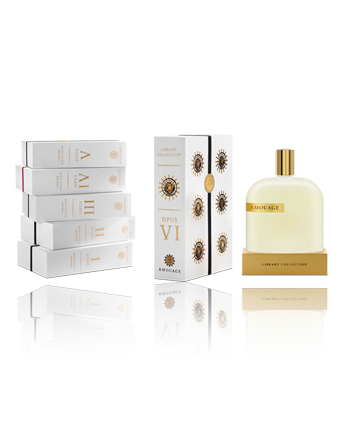
foto: Amouage.com

Amouage Opus VI – Eternal Sunshine

It is not often that I expect the postman with such anxiety or greet him with a kiss on the cheek but this time I was really eager to lay my nostrils on Amouage‘s latest release, Opus VI.

Olfactorily more linked to Opus V than to any other fragrance from the Library Collection, it instantly became my favorite Opus dethroning my beloved, the nostalgic and violet-tinged Opus III.

The fragrance was inspired by the film Eternal Sunshine of the Spotless Mind or, more specifically, “by the destruction and reinvention of knowledge and memories”. The design on the box represents eternity as broken memories, symbolising the end of a love affair.

I find Opus VI a fragrance of dualities (simple/complex, feminine/masculine, past/present, unity/fragmentation) that cleverly embodies the desired concept under the guise of an incredibly modern and lightweight amber.

Opus VI is equally ambery, leathery and woody; equally masculine and feminine. The warm  notes merge together so smoothly, it gives an accomplished sense of unity and seems deceptively simple at the same time. It is modern and streamlined yet there’s something that smells atavic and primitive about it…what could be more primitive than leather and wood?

Notes, according to Amouage, are: Sichuan pepper, frankincense and  St Thomas bay in the opening. Periploca, cypriol (the Indian nagarmotha, related to papyrus) and patchouli in the heart, over a base of Ambranum, Z11, sandalwood and cistus. I truly appreciate the fact that Amouage has started to list synthetics among the notes of their fragrances, another smart move from Creative Director Christopher Chong

I guess I would be glad to have an eternal and untainted love story with Opus VI.

Caro

Origin of sample: Sample courtesy of Amouage

Dior Dioressence (vintage) – Golpe de genialidad

imagen: Liveauctioneers.com            ilustración: René Gruau

En 1969, mi venerado Guy Robert fue comisionado por Dior para componer un nuevo perfume. La fragancia en sí sería de carácter muy animal y se publicitaría como “le parfum barbare”. El nombre ya estaba listo: Dioressence.  

Luego de varios intentos infructuosos, la inspiración le llegó a Monsieur Robert cuando, para eliminar restos de ambargris de sus manos, las lavó con un jabón imitación de Miss Dior*. Al olerlas luego:“voilá!”, allí estaba el aroma animal que había estado buscando. Así nació el primer perfume oriental de Dior.  Durante una expedición de “caza de perfumes” tuve la buena fortuna de encontrar un diminuto frasco de 1/4 de onza en una tienda igualmente pequeña. 

Au débouché, percibo geranio, rosa, canela y patchouli, pero al aplicarlo en las muñecas, Dioressence se transforma en el oriental especiado más suave que pueda imaginarse, rico y cremoso. Su oscura sensualidad se ve realzada por vainilla, patchouli y una bellísima nota de ambargris.  El sillage es mucho más avainillado que la fragancia misma pero – tratándose de concentración parfum–  de todos modos el aroma permanece cerca de la piel. 

Dioressence corporiza perfectamente el zeitgeist de los 1970s y comparte características con YSL Opium y Estee Lauder Youth Dew, aunque huele más vigente que ellos.  Lejos de tener carácter meditabundo o introspectivo, Dioressence exige ser portado fuera de casa y con ánimo festivo.

Caro

Origen de la muestra: frasco comprado en perfumería Togat’s, Buenos Aires.

*Miss Dior había sido creado en 1947 por Jean Carles y Paul Vacher. El líquido que se vende hoy bajo el mismo nombre guarda poca o ninguna similitud con el original.

foto: Profumo.it

Dior Dioressence (vintage) – Stroke of genius

In 1969, my worshipped Guy Robert was commissioned by Dior to compose a new fragrance. The scent itself should be very animalic and would be advertised as “le parfum barbare”. They already had the name: Dioressence.

After a few fruitless trials, inspiration struck Monsieur Robert when he washed off some ambergris from his hands with a Miss Dior* knockoff soap. He smelled his hands and “voilá!”, there was the animalic scent he had been searching for. Thus Dior‘s first oriental fragrance was born. During one of my fragrance hunting expeditions, I was fortunate enough to find a tiny 1/4 oz vial of vintage parfum in an equally tiny fragrance store.

Au débouché, I perceive geranium, roses, cinnamon and patchouli. But after dabbing it on my wrists, Dioressence develops into the smoothest spicy oriental, creamy and rich. Its dark sensuality is enhanced by vanilla, patchouli  and the most beautiful ambergris note imaginable. The sillage is a lot more vanillic than the fragrance itself but -this being parfum concentration- the scent stays quite close to the skin.

Dioressence embodies perfectly well the zeitgeist of the 1970s and shares a certain vibe with YSL Opium and Estee Lauder Youth Dew but manages to smell more current than them. Far from being meditative or introspective, Dioressence demands to be worn out of the house and with a festive mood.

Caro

Origin of sample: vial bought at Perfumería Togat’s, Buenos Aires

*Miss Dior had been created in in 1947 by Jean Carles and Paul Vacher.The juice sold today under the same name bears little to no resemblance to the original.

Rancé 1795 Laetitia – Madame Mère

imagen: costumes.org

La familia Rancé comenzó a producir guantes perfumados en Grasse, en los años 1600. A finales del siglo siguiente, se especializó en la elaboración de fragancias finas. Se dice que Francois Rancé fue el perfumista favorito de Napoleón y que creó varios perfumes para él. Hoy la casa basa su éxito en la imaginería bonapartiana que inspira sus mezclas y en la gran calidad de sus delicadas fragancias, que agradan especialmente a aquellos de gustos clásicos.

Laetitia fue inspirado por Maria Letizia Ramolino (1750-1836), madre de Napoleón. Nacida en Córcega en el seno de una familia noble, esta mujer fuerte y de belleza severa montaba a caballo durante sus embarazos, insistía en que sus niños se bañaran día por medio en una época en la que una vez al mes era considerada suficiente y se rehusó a aprender Francés incluso luego de que Córcega pasara a formar parte de Francia. Enseñó a sus hijos -a través del ejemplo- moderación en la prosperidad y grandeza de alma ante la adversidad.

Al rociar el perfume, una nube cítrica y especiada de bergamota,  mandarina  y nuez moscada eleva instantáneamente nuestro ánimo. En seguida se manifiesta una fuerte nota de patchouli que envuelve un radiante corazón floral de rosa búlgara, azahar, glicina y magnolia. Las flores prestan sofisticación a esta mezcla donde impera el patchouli y la cálida cualidad solar del azahar y la magnolia se hace especialmente evidente.

En una base maravillosamente dorada el ambar, la vainilla y el bálsamo de Tolu  logran endulzar la mezcla, pero es -¡Sí, adivinaron!- el omnipresente patchouli quien brinda equilibrio y evita que el perfume se torne empalagoso.

Laetitia huele muy natural (un rasgo común a todas las propuestas de Rancé) y tiene una longevidad excelente. Es una fragancia refinada pero desprovista de timidez y enfática sin rozar la vulgaridad. Como la mismísima Madame Mère.

Caro

Origen de la muestra: muestra cortesía de Perfumería Nadia, Madrid

foto: zentraldrogerie.com

Rancé 1795 Laetitia – Madame Mère

The Rancé family started producing perfumed gloves in Grasse in the 1600s. In the late 1700s, they specialized in the making of fine fragrances. It is said  Francois Rancé was Napoleon‘s favorite perfumer and that he created many perfumes for him. Today the house bases its success on the Bonapartian imagery that inspires their blends and in the great quality of their delicate fragrances which appeal mostly to classical tastes.

Laetitia was inspired by Maria Letizia Ramolino (1750-1836), mother of Napoleon. Born in Corsica to a noble family, she was a strong woman of severe beauty who rode horses through her pregnancies, insisted that her children  should bathe every other day in a time when once a month was the norm and refused to learn French even after Corsica became part of France. She taught -through example- moderation during prosperity and greatness of soul during adversity.

Upon spraying the fragrance, a citrusy and spicy cloud of bergamot,  mandarine and nutmeg instantly lifts our moods. Soon a strong patchouli note envelops the radiant floral heart of Bulgarian rose, orange blossom, wisteria and magnolia. The flowers lend sophistication to the patchouli-dominant blend and the warm solar quality of orange blossom and magnolia is especially evident.

In a wonderfully golden base amber, vanilla and Tolu balsam manage to sweeten the fragrance, but it is -you guessed it- the omnipresent patchouli which provides balance and prevents the blend from becoming too sweet.

Laetitia smells very natural (a trait common to all Rancé offerings) and has excellent longevity.  The fragrance is refined but devoid of shyness and emphatic without verging on vulgarity. Just like Madame Mère herself.

Caro

Origin of sample: sample courtesy of Perfumería Nadia, Madrid

Lalique Perles de Lalique – Perlas, pimienta y rosas

imagen: Artbrokerage.com     Erté       “Bijoux de Perles”

¡Ah, Perles de Lalique, mi fiel compañero! Prueba fehaciente de que  las fragancias comerciales no necesariamente huelen aburridas, genéricas y baratas.

Despertó mi intriga no bien lo probé en la perfumería, pero -optando por algo más familiar- compré el avainillado Lalique Le Parfum. En el curso de las semanas siguientes, volví unas cuantas veces con la intención de insistir con Perles. Aun indecisa, intuía que la fragancia tenía algo especial. Me tomó unas cuantas visitas, pero desde aquel día decisivo, no he tenido arrepentimientos: lo llevo de igual manera en invierno y en verano (aprecio particularmente su cualidad seca en días calurosos), me resulta suficientemente limpio para el trabajo aunque sensual como para una salida romántica, es transparente Y persistente. No es difícil entender por qué lo he adoptado como caballito de batalla.

Creado por Nathalie Lorson en 2006Perles es descrito como un chipre moderno. Me cuesta un poco entender a los ”chipres modernos” como “chipres verdaderos” así que prefiero clasificarlo como un transparente floral especiado  y amaderado; aerodinámico si no minimalista en carácter.

Notas que tradicionalmente son densas aquí se tornan aireadas, como si una brisa soplara a través de la pimienta, la rosa, el vetiver y patchouli, dispersando su aroma.  Luego del estallido pimentoso inicial, el desarrollo es bastante lineal, con un final amaderado que creo cortesía del iso E super. La rosa búlgara  tiene una marcada presencia, pero este no es un perfume típicamente femenino. En absoluto. Insisto en mi creencia de que los perfumes no tienen género y este es un cabal ejemplo. Perles de Lalique bien podría ser la hija pequeña de Terre d’Hermes y Parfum Sacré; la hermana alegre de Paestum Rose, que cambia la solemnidad por un poquito de insolencia y el misterio por risitas.

Este perfume es fácil de encontrar y puede ser adquirido por un precio razonable. A pesar de su cualidad transparente, la longevidad es sorprendentemente buena.

Caro

Origen de la muestra: Botella comprada en Perfumería Hapes, Buenos Aires

foto: Lalique.com

Lalique Perles de Lalique – Pearls, pepper and roses

Ah, Perles de Lalique, my faithful companion! Concrete proof that mainstream fragrances need not smell boring, generic or cheap.

It got me intrigued as soon as I tried it at the store but -opting for something more familiar- I bought the vanillic Lalique Le Parfum instead. Over the course of the following weeks, I returned a few times in order to try Perles again. Unsure as I was, there was still something special about it. It took me a few visits but, since the decisive day when I purchased it, I have never looked back: I wear it on Winter and Summer alike (its dry quality is enjoyable in hot weather), I find it clean enough for work yet sensual enough for a romantic evening, it is both transparent AND persistent. It’s not difficult to understand why I have adopted it.

Created by Nathalie Lorson in 2006Perles is described as a modern chypre. I have a hard times thinking of “modern chypres” as “true chypres” so I’d rather classify this as a transparent spicy woody floral; streamlined, if not minimalistic in character.

Traditionally dense notes get airy here, as if a breeze was blowing through the pepper, the rose, the vetiver and patchouli, dispersing their scent.  After the initial peppery burst, the development is fairly linear, with a woody drydown I guess courtesy of iso E super. The Bulgarian rose has a marked presence but this is not your typical feminine scent. Not at all. I sustain the belief that fragrance is genderless and this is one wonderful example. Perles de Lalique could well be youngest daughter of Terre d’Hermes and Parfum Sacré; Paestum Rose‘s cheerful sister, who trades the solemnity for a little bit of insolence and the mystery for giggles.

This fragrance is easily available  and can be purchased at a reasonable price. Despite its transparent quality, I find the lasting power surprisingly good.

Caro

Origin of sample: Bottle purchased at Perfumería Hapes, Buenos Aires

Les Parfums de Rosine Une Rose au Bord de la Mer – Gentil brisa marina

imagen: Bertc.com        John George Brown        “Sunshine”, 1879

Perpetúo con convicción la creencia de que la rosa es la indiscutida reina de las flores. Puede presentarse bajo infinidad de aspectos. Sus colores abarcan desde el blanco más puro a casi negro; del lila pálido a  las tonalidades ígneas del atardecer. Su aroma puede ser punzante, licoroso, seco o embriagadoramente dulce y con reminiscencias de miel.

Les Parfums de Rosine, casa fundada por Marie Helene Rogeon, rinde adecuado tributo a la esta flor y sus muchas encarnaciones. Sus perfumes son bonitos, despojados de pretensiones y sólidamente construídos. Hoy me topé con el más ligero de todos ellos.

Une Rose Au Bord de la Mer  -disponible sólo en concentración Eau Fraîche– es un floral marino, una variación sobre Ecume de Rose.  Aquí “marino” no debería entenderse como acuático sino como referente a las inmediaciones del mar. Abre cítrico, con naranja amarga, mandarina y una bergamota aún más pronunciada.

En el corazón, el absoluto de rosa  se combina con jazmín mientras que una nota de siempreviva evoca los pastos silvestres que crecen entre la arena.  Al igual que la brisa marina, este perfume salpica ligeramente con espuma salada y trae un ligero matiz metálico que recuerda al olor del yodo. Lo encuentro tan vigorizante como una caminata junto al mar.

Durante el transcurso del día, inmersa en otros pensamientos, buscaba a mi alrededor tratando de detectar el origen de este mágico aroma. Si el color blanco tuviera un olor, seguramente sería muy parecido a este. Une Rose Au Bord de la Mer logra conservar su cualidad etérea a través del fondo almizclado. 

Caro

Origen de la muestra: Cortesía de Perfumería Nadia, Madrid

foto: Liberty.co.uk

Les Parfums de Rosine Une Rose au Bord de la Mer – Gentle sea breeze

I strongly sustain the belief that rose is the indisputed queen of flowers. She can take many guises: her color can range from the purest white to almost black; from pale lilac to the fiery hues of sunset. Its smell can be piquant, boozy, dry or inebriatingly sweet, redolent of honey.

Les Parfums de Rosine, a house founded by Marie Helene Rogeon, pays fitting tribute to this flower and its many incarnations. Their fragrances are pretty, devoid of pretense and solidly constructed. Today I met the lightest of them all.  

Une Rose Au Bord de la Mer  -available only in Eau Fraîche concentration- is a marine floral, a variation on Ecume de Rose.  Here “marine” shouldn’t be understood as aquatic but more like the environs of the sea. It opens citrusy, with bitter orange, mandarin and an even more pronounced bergamot.

In the heart, rose absolute is paired with jasmine while an immortelle note evokes the wild grass growing in the sands.  Much like the seaside breeze, this fragrance splashes lightly with salty froth and bears a slight metallic tinge that evokes the smell of iodine. I find it as invigorating as a stroll by the sea.

During the course of the day, immersed my thoughts, I kept looking around to find where this magical aroma was coming from. If the color white had a scent, it would surely be akin to this. Une Rose Au Bord de la Mer manages to retain its ethereal quality well through the musky drydown. 

Caro

Origin of sample: Sample courtesy of Perfumería Nadia, Madrid