Tag Archives: sándalo – sandalwood

Grossmith Hasu-no-Hana – Una calma sensualidad

imagen: Reproductionsart.com        artista: William Merritt Chase       “Peonies”

Ya he presentado brevemente a la casa Grossmith en la reciente review de su romántico perfume Betrothal.

Cuando la versión original de Hasu-no-Hana nació, en 1888, el Japonismo era furor en Europa. Hoy esta fragancia ha sido resucitada por Simon Brooke con la  ayuda del experto Roja Dove, manteniendo la fórmula lo más cercana posible a su encarnación primitiva. Promocionado como ”el aroma del loto japonés”, Hasu-no-Hana -fiel a su origen japonista- tiene mucho más que ver con una visión occidental e idealizada del Japón que con cualquier otra cosa remotamente japonesa.

No se percibe ni pizca de loto en este chipre oscuro pero radiante. La fragancia abre verde y amarga (bergamota y naranja amarga  dejan clara su presencia) mas pronto se torna dulzona y floral, gracias a un delicioso bouquet anticuado de rosa, jazmín e ylang-ylang. Más tarde muta en un sensual y atalcado lecho de cedrosándalo y tonka.

La sensación general es un tanto densa, pero las transiciones de nota a nota y de una etapa a otra no presentan fisura. Posee un efecto casi hipnótico y reconforta sin perder elegancia ni complejidad.

Hasu-no-Hana  huele como un producto de otra era.  Prefiero definirlo como atemporal más que como viejo, aunque la vejez no va en detrimento de la magnificencia: un Stradivarius es viejo y también lo es ”El Nacimiento de Venus”, de Botticelli.

Posee la mejor longevidad de toda la línea y se ha convertido -por el momento- en mi favorito de la casa Grossmith.

Caro

Origen de la muestra: muestra cortesía de Perfumerías Nadia, Madrid

foto: Grossmithlondon.com

Grossmith Hasu-no-Hana – A calm sensuality

I have already briefly introduced the house of Grossmith in my recent review of their romantic Betrothal.

When the original version of Hasu-no-Hana was born, in 1888, Japonism was all the rage in Europe. It has now been resurrected by Simon Brooke with the help of fragrance expert Roja Dove, keeping the formula as faithful to the original as posible. Touted as “the scent of the Japanese lotus lily”, Hasu-no-Hana -true to its japonist origin- has a lot more to do with an Occidental idealised view of Japan than with anything remotely Japanese.

I don’t get the slightest hint of lotus lily in this radiant yet dark chypre. The fragrance opens green and bitter (bergamot and bitter orange make their presence  clear) but soon gets sweetish, more floral, thanks to a deliciously old-fashioned bouquet of rose, jasmine and ylang-ylang. It later morphs into a sensual and powdery woody bed of cedarwoodsandalwood and tonka.

The feel is somewhat dense, but the transitions from note to note and from one stage to another are seamless. It has an almost entrancing effect and comforts without losing elegance or complexity. Hasu-no-Hana smells like something from another era.  I would rather call it timeless than old, even though age does not detract from magnificence: a Stradivarius is old and so is Botticelli’s “The Birth of Venus” for that matter.

It boasts the best longevity in the Grossmith range and is, so far, my favorite from the house.

Caro

Origin of sample: Sample courtesy of Perfumerías Nadia, Madrid

Grossmith Betrothal – Amor eterno

foto: En.wikipedia.org

Grossmith, una de las casas de perfumería más antiguas de Inglaterra, fue fundada en Londres en 1835 por John Grossmith. La empresa fue dirigida por la familia durante tres generaciones hasta 1924. Cambió de manos en 1970 y cesó sus actividades por completo alrededor de 1980.

Simon Brooke -tataranieto del fundador-  inició el revival de Grossmith  hace unos pocos años con el objetivo de reestablecer la reputación de la Casa como elaboradora de algunos de los perfumes de mejor calidad del mundo. Para esto, trabajó estrechamente con el experto en fragancias Roja Dove.

En 2009 la Casa relanzó tres perfumes ingleses clásicos – Hasu-no-Hana, Phul-Nana y Shem-el-Nessim – que huelen fabulosamente a otra era, mucho más espléndida (escribiré acerca de ellos en futuros posts).  La primera de sus fragancias modernas, Betrothal, fue lanzada el día de la Boda Real en Londres, el 29 de abril de 2011.

La versión original de Betrothal fue producida para celebrar la boda de la Princesa May de Teck y el Príncipe Jorge (más tarde Reina Mary y Rey George V) en 1893, quienes luego disfrutarían de un matrimonio lleno de amor y respeto. El nuevo Betrothal es una fragancia contemporánea inspirada por la fórmula original; un bouquet floral y romántico en el que el aroma transparente y dulce de la Rose de Mai –la rosa que le da fama a Grasse- reina suprema.

Después de una salida encantadora y chispeante con neroli y bergamota (también percibo geranio),  la nota amielada de la Rose de Mai se entreteje con  jazmín ylang ylang. La rosa parece entrar y salir de la composición. Aun cuando definitivamente este no es un solifloral, hay momentos en los que al usarlo me pregunto qué es lo que irradia ese mágico aroma a rosa…hasta que me doy cuenta de que soy yo misma. Las flores descansan sobre un mullido lecho de cálidas maderas (cedro, sándalo), vainilla almizcle.

Betrothal es discreto y grácil y, sin embargo, suavemente sensual. Es clásico en carácter, pero también chispeante y en absoluto anticuado. Su bella composición hace añorar una época en que las muchachas no andaban por ahí oliendo a chocolate, azúcar y frutas.

Me encantaría probar una versión más concentrada de Betrothal: el parfum es el próximo en mi lista.

Caro

Origen de la muestra: muestra gentileza de Perfumerías Nadia, Madrid

foto: Grossmithlondon.com

Grossmith Betrothal – Eternal love

Grossmith, one of England’s oldest perfume houses, was founded in London in 1835 by John Grossmith. The business was family run for three generations until 1924. It went out of family ownership in 1970 and stopped its activities completely around 1980.

Simon Brooke -great, great grandson of the founder-  began the revival of Grossmith a few years ago with the objective of re-establishing the House’s reputation as makers of some of the finest fragrances in the world.  For this, he worked closely with fragrance expert Roja Dove.

In 2009 the House relaunched three classic English perfumes – Hasu-no-Hana, Phul-Nana and Shem-el-Nessim – that smell fabulously of another, more splendid, era (I will write about them in a future post). Betrothal, the first of their modern fragrances, was launched on the day of the Royal Wedding in London on 29 April 2011.

The original Betrothal was produced to celebrate the wedding of Princess May of Teck and Prince George (later Queen Mary and King George V) in 1893, who would enjoy a loving and respectful marriage. The new Betrothal is a contemporary fragrance inspired by the original formula; aa romantic, floral bouquet in which the clear sweet scent of Rose de Mai –the rose that gives fame to Grasse- reigns supreme.

After a charming bright opening of neroli and bergamot (I get  geranium too),  the honeyed note of Rose de Mai is tightly interwoven with jasmine and ylang ylang. The rose wafts in and out of the composition. While this is definitely not a soliflore, sometimes when I wear it I wonder where that beautiful rose aroma  radiates from…until I realise it’s me. The florals rest on a soft bed of  warm woods (cedarwood, sandalwood), vanilla and musk.

Betrothal is ladylike and graceful yet softly sensual. It is classic in character  but sparkling, not at all dated. Its beautiful composition makes me long for a time when young girls didn’t run around smelling of chocolate, sugar and fruit.

I would love to try a more concentrated version of Betrothal: the parfum is next in my list.

Caro

Origin of sample: sample courtesy of Perfumerías Nadia, Madrid

Robert Piguet Visa – Para comerte mejor

foto: Nycityeats.com

Aunque la bomba sexy Fracas y la chica mala Bandit sean probablemente las primeras en acudir a la mente cuando se menciona la casa Piguet, todas las fragancias de su línea clásica valen la pena ser probadas.  

Visa, un embriagador gourmand oriental, fue creado por Germaine Cellier, en 1945, durante la vida del couturier Robert Piguet. Mucho más tarde, en 2007, fue reorquestado por Aurelien Guichard y es esa versión la que se encuentra disponible hoy.

Promocionado como “el pasaporte (de quien lo porta) a un encuentro exótico”, Visa no  resulta tan extraño como sugiere el slogan, aunque sí especialmente adictivo y apetitoso. Este gourmand perfectamente equilibrado y que conjura frutas maduras (bergamota,  mandarina y pera, pero más manifiestamente durazno), desbordantes de néctar, me mantiene oliendo febrilmente mis muñecas. 

El corazón es ricamente floral, presidido por un bouquet clásico de flor de naranjo, rosa e ylang-ylang. Notas amaderadas de patchouli y sándalo prevalecen en el fondo, que es dulce, avainillado y suavemente polvoriento, evocador de cuero (¿Las valijas infaltables para este viaje?) fino espolvoreado con azúcar impalpable. Suena extraño, huele delicioso.

Visa es un claro ejemplo de cómo deben ser los gourmands: complejos y  seductores, mas nunca literales. No huele como un postre, pero inspira ganas de serlo.

Caro

Origen de la muestra: cortesía de Perfumerías Nadia, Madrid

foto: Robertpiguetparfums.com

Robert Piguet Visa – The better to eat you with

While bombshell Fracas and bad girl Bandit are probably the first perfumes that spring to mind when the house of Piguet is mentioned, all of their classic fragrances are worth a try.  

Visa, an inebriating oriental gourmand, was created by Germaine Cellier in 1945, during couturier Robert Piguet‘s lifetime. It was reorchestrated, much later, in 2007, by Aurelien Guichard and that is the version which is available today. Touted as “its wearer’s passport to an exotic encounter”, we find Visa far less exotic than the slogan suggests but nonetheless addictive and mouthwatering.

A perfectly balanced gourmand that conjures ripe fruits (bergamot,  mandarin  and pear, but most prominently peach), dripping with nectar, it keeps me feverishly sniffing my wrists. The heart is richly floral, presided by a classical bouquet of orange flower, rose and ylang-ylang. Woody notes of patchouli and sandalwood prevail in the drydown which is sweet, vanillic and softly powdery, evocative of fine leather (the indispensable suitcases for this journey?) sprinkled with icing sugar. Sounds weird, smells delicious.

This is, we think, what gourmands should be like: complex, seductive but never literal. It doesn’t smell like dessert but inspires one to become one.

Caro

Origin of sample: Courtesy of Perfumerías Nadia, Madrid

Amouage Opus VI – Eterno resplandor

imagen: Fanpix.net

No me sucede a menudo esto de esperar al cartero con  anhelo ni saludarlo con un beso en la mejilla, pero esta vez realmente ansiaba poner mis narices sobre el último lanzamiento de Amouage, Opus VI.

Olfatoriamente más conectado con Opus V que con ninguna otra fragancia de la Library Collection, instantáneamente se convirtió en mi  Opus  favorito, destronando a mi amado, el nostálgico y teñido de violetas Opus III.

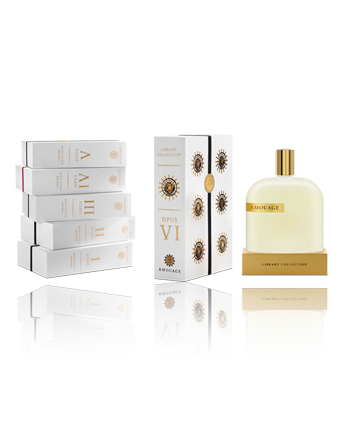
El perfume fue inspirado por el filme Eterno Resplandor de la Mente sin Recuerdos o, más específicamente, “por la destrucción y reinvención del conocimiento y los recuerdos”. El diseño de la caja representa la eternidad como recuerdos rotos, simbolizando el fin de un affaire amoroso.

Opus VI se presenta como una fragancia de dualidades (simple/complejo, feminino/masculino, pasado/presente, unidad/fragmentación) que inteligentemente encarna el concepto deseado bajo la forma de un ámbar increíblemente moderno y liviano.

Opus VI es igualmente ambarado, acuerado y amaderado; igualmente masculino y femenino. Las cálidas notas se funden unas con otras tan suavemente que da una cabal sensación de unidad y parece engañosamente simple a la vez. Es moderno y minimalista y sin embargo algo en él huele atávico y primitivo…¿Qué podría ser más primitivo que el cuero y las maderas? 

Las notas, según Amouage, son: pimienta de Szechuan,  incienso  pimenta racimosa en la salida. Periploca, cipriol (el nagarmotha indio, emparentado con el papiro) y patchouli en el corazón, sobre una base de Ambranum, Z11, sándalo y cistus. Realmente aprecio el hecho de que Amouage haya empezado a listar los sintéticos usados entre las notas de sus fragancias, otra oportuna jugada del Director Creativo Christopher Chong.

Por mi parte, estaría encantada de vivir una eterna e inmaculada historia de amor con Opus VI.

Caro

Origen de la muestra: Muestra gentileza de Amouage

foto: Amouage.com

Amouage Opus VI – Eternal Sunshine

It is not often that I expect the postman with such anxiety or greet him with a kiss on the cheek but this time I was really eager to lay my nostrils on Amouage‘s latest release, Opus VI.

Olfactorily more linked to Opus V than to any other fragrance from the Library Collection, it instantly became my favorite Opus dethroning my beloved, the nostalgic and violet-tinged Opus III.

The fragrance was inspired by the film Eternal Sunshine of the Spotless Mind or, more specifically, “by the destruction and reinvention of knowledge and memories”. The design on the box represents eternity as broken memories, symbolising the end of a love affair.

I find Opus VI a fragrance of dualities (simple/complex, feminine/masculine, past/present, unity/fragmentation) that cleverly embodies the desired concept under the guise of an incredibly modern and lightweight amber.

Opus VI is equally ambery, leathery and woody; equally masculine and feminine. The warm  notes merge together so smoothly, it gives an accomplished sense of unity and seems deceptively simple at the same time. It is modern and streamlined yet there’s something that smells atavic and primitive about it…what could be more primitive than leather and wood?

Notes, according to Amouage, are: Sichuan pepper, frankincense and  St Thomas bay in the opening. Periploca, cypriol (the Indian nagarmotha, related to papyrus) and patchouli in the heart, over a base of Ambranum, Z11, sandalwood and cistus. I truly appreciate the fact that Amouage has started to list synthetics among the notes of their fragrances, another smart move from Creative Director Christopher Chong

I guess I would be glad to have an eternal and untainted love story with Opus VI.

Caro

Origin of sample: Sample courtesy of Amouage

Amouage Epic Woman – Recorriendo la Ruta de la Seda

imagen: Asiasociety.org    artista: Wu Guanzhong     “Camels in the Desert”, 1981

La casa  Amouage fue fundada en 1983 en el sultanato de Omán; su director creativo – Christopher Chong– tiene base en Londres; las fragancias se desarrollan en Grasse -en el sur de Francia- y  se venden en más de 30 países. A pesar de hacer un uso generoso de materias primas de origen omaní (incienso, oud, rosa damascena) Amouage desafía las etiquetas geográficas y se inspira en un crisol multicultural.

“Opulencia” sería una palabra atinada para describir de manera general la línea clásica de Amouage,ya que sus perfumes difícilmente podrían encontrarse más lejos del minimalismo. La profusión de notas suele lograr, sin embargo, un equilibrio magnífico y su exuberancia -como la del arte barroco- no va en detrimento de la armonía.

Epic Woman es un floral oriental especiado -muy especiado-  que se inspira en la antigua y legendaria Ruta de la Seda que iba de China a Arabia. Su carácter es tan seco y cálido como la nube de arena que queda en el desierto tras el paso de una caravana y, al igual que aquella, es denso pero no opaco.
Esta sequedad, sin embargo, entraña un ligero dulzor que remite al aroma del papel de antiguos libros y -a pesar de la tonalidad esmeralda de la botella- al olerlo percibo todo como teñido por una paleta de ocre, azafrán y terracota, con algunas pinceladas de incienso gris plata.

Al rociarlo sobre la piel, comino y canela se fusionan en una polvareda ligeramente picante que da paso al geranio y a la rosa: una rosa especiada y de carácter seco que parece dirigir la caravana. Una nota de incienso resinoso se hace presente y acompaña a la rosa hasta que ésta se aparta a un lado. Luego, el omnipresente incienso se entreteje apretadamente con patchouli, sándalo y almizcle.

La abundancia de maderas preciosas e incienso aleja a  Epic Woman de los estereotipos de los perfumes femeninos. Su longevidad es fabulosa.

Aunque la primera reacción sea encasillarlo como un perfume invernal dada la abundancia de especias,  también sería una maravillosa opción para usar en verano, especialmente en una noche cálida, fuera de la ciudad.

Caro

Procedencia de la fragancia: muestra cortesía de Amouage

foto: Amouage.com

Amouage Epic Woman – Along the Silk Road

The House of Amouage was founded in Oman, in 1983; itsCreative Director –Christopher Chong– is based in London; the fragrances are developed in Grasse, in the South of France, and sold in over 30 countries. Despite a prodigal use of Omani raw materials (silver frankincense, oud, rosa damascena) Amouage defies geographical labels and takes its inspiration from a multicultural melting pot.

“Opulence” would be an accurate word to describe Amouage’s classic line in broad terms since the fragrances couldn’t be situated farther from minimalism. However, the profusion of notes in most cases achieves a magnificent equilibrium and their exuberance -like that of Baroque art- doesn’t deter from harmony.

Epic Woman is a spicy -very spicy-  floral oriental that was inspired by the ancient and legendary Silk Road that went from China to Araby. Its character is as warm and dry as the sand cloud that a caravan leaves in the desert after itself and, much like it, it is dense but not opaque. Its dryness, however, holds a slight sweetness that evokes the smell of old book pages and -despite the emerald  shade of the bottle- when I smell it I perceive everything as tinged by a palette of ochre, saffron and terracotta with a few silvery brushstrokes of frankincense.

Upon spraying on the skin, cumin and cinnamon fuse together in a slightly spicy cloud of dust which makes way for geranium and rose: a dry  rose that seems to command the caravan. A resinous note of  frankincense appears in the scene and joins the rose , which moves aside. The omnipresent frankincense then becomes tightly interwoven with patchouli, sandalwood and musk.

The abundance of precious woods and frankincense takes Epic Woman away from the stereotypes of feminine fragrances. Its longevity is fabulous.

Although the first impulse would be to label it as a cold weather fragrance, due to the abundance of spices, it would be a wonderful option to be worn on a warm Summer evening, away from the city.

Caro

Origin of sample: Sample courtesy of Amouage