Tag Archives: iris

Jovoy Paris Rouge Assassin – Lápiz labial rosado

imagen: Hprints.com   ilustrador: Chéri Herouard para La Vie Parisienne, 1919

imagen: Hprints.com     ilustrador: Chéri Herouard   (La Vie Parisienne, 1919)

Jovoy es una perfumería establecida en París que abrió sus puertas por primera vez en 1923; fue reabierta en 2010 y hoy ofrece una amplísima gama de fragancias para conocedores, entre ellas su propia marca. Conocí Rouge Assassin durante un viaje. En aquel momento tenía tal resfrío que todavía me pregunto cómo logré percibir sus delicadas notas y conservar el recuerdo. Grande fue mi alegría cuando Virginia, de paso en Buenos Aires,  trajo consigo una botella.

Rouge Assassin fue compuesto por Amélie Bourgeois (Flair). Según Jovoy: “Dos tipos de mujeres de los años veinte se cruzan en el mismo espacio sin conocerse jamás:  Una es ‘la maitresse de ces messieurs’, una amante según la tradición del Segundo Imperio (estas elegantes mujeres mantenidas se contaban entre las primeras clientas de Jovoy) y la “garçonne”, un término para la mujer emancipada, cuyo aspecto podrá haber sido por momentos andrógino, pero que fue la primera en la historia de la moda femenina en revelar sus piernas. Pronto los brassieres  reemplazarían a los corsets. Las medias gruesas desaparecieron en favor de otras de seda, que se lucían enrolladas sobre una liga por encima de las rodillas. Fue en esta época que aparecieron los primeros lápices labiales.  Rouge Assassin rinde tributo a esas mujeres temerarias e imparables que subvirtieron el orden establecido y rompieron todas las reglas.”

Rouge Assassin -a pesar de su nombre- no resulta oscuro, salvaje ni agresivo. Quizás un exceso de fragancias animales y operáticas me haya echado a perder,   pero me aventuraría a describirlo como inocente. Este es un coqueto floral almizclado que flota alrededor del usuario y murmura con suavidad; demasiada suavidad a menos que recuerde aplicarlo en abundancia. Parece más evocador de las pálidas damas de la Belle Époque que de las independientes  flappers de los 1920s: no hay alusiones al Orientalismo, no hay maderas exóticas, no hay tabaco.

Me gusta leer a Rouge Assassin como un relato olfativo sobre la transición que hicieron las mujeres en los primeros años del siglo XX: un floral atalcado suave (rosa, iris, polvos de arroz) es atravesado por un trazo de lápiz labial sutil pero definido que le presta una textura cerosa. La sensación general,más moderna que histórica o retro, es realzada por almizcles blancos y maderas lustradas. Estas últimas le confieren una cierta profundidad; si bien no lo oscurecen demasiado.

En resumen, en lugar del arma letal que el nombre insinúa, encuentro un eau de parfum delicadamente sugestivo, incluso lúdico. Su sillage es discreto y la longevidad, excelente. Recomiendo una aplicación pródiga a fin de poder apreciar mejor sus matices.

Caro

Origen de la muestra: Botella comprada en Scent Bar, L.A.

Gaia Fishler, de The Non Blonde lo describe como pleno y seductor. Si quieren leer sus impresiones, pueden encontrarlas aquí. 
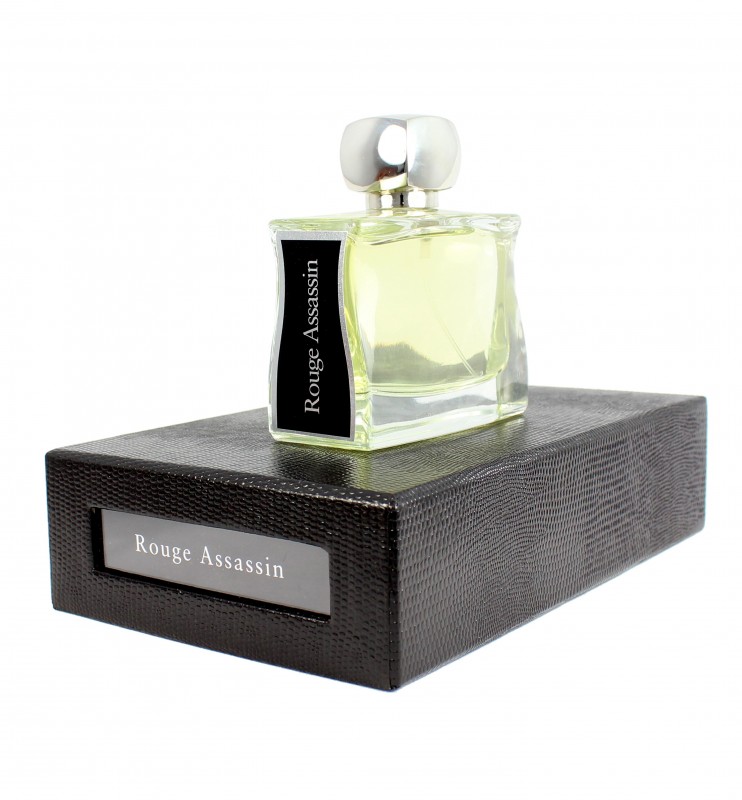
foto: Jovoyparis.com

foto: Jovoyparis.com

Jovoy Paris Rouge Assassin – Pink lipstick

Jovoy is a Paris based perfumery which opened its doors for the first time in 1923; restored in 2010, it now offers a vast array of fragrances for connoisseurs, among these, their own namesake brand. I first came across Rouge Assassin during a trip. I had such a terrible cold at the time, I wonder how I ever managed to perceive its delicate notes and keep their memory with me. Great was my joy when Virginia  brought a bottle along with her on her recent visit.

Rouge Assassin was composed by Amélie Bourgeois (Flair). According to Jovoy: “Two types of women from the Twenties mingle in the same space without ever really meeting:  One is ‘la maitresse de ces messieurs’, a mistress in the tradition of the Second Empire (such chic kept women were among Jovoy’s first clients) and  the “garçonne”, a term for the emancipated woman, whose look may have been androgynous at times, but who was the first in the history of women’s fashion to reveal her legs. Soon, brassieres would replace corsets. Thick stockings vanished in favor of silk ones worn rolled over a garter above the knee. It was at this time that the first lipsticks appeared.  Rouge Assassin pays tribute to those fearless, unstoppable women who upended the established order and broke all the rules.”

Rouge Assassin -despite its name- is not dark, wild or aggressive. I might have been spoiled by excessively operatic and animalic fragrances, but I would go far and describe it as innocent. This is a coquettish musky floral that floats around the wearer and whispers softly; too softly if don’t remember to spritz prodigally. It appears more evocative of the pale ladies of the Belle Époque than the  independent flappers of the 1920s: there are no allusions to Orientalism, no exotic woods, no tobacco.

I like to read Rouge Assassin as an olfactory tale of the transition women underwent in the early years of the XX century: a soft powdery floral (rose, iris, rice powder) becomes pierced by a subtle but definite stroke of lipstick which lends a waxy texture. The overall feel, more modern than historic or retro, is enhanced by white musks and waxed woods.The latter lend a certain depth but do not darken the composition.

All in all, instead of the lethal weapon its name implies, I find a softly suggestive, even playful, eau de parfum. Sillage is discreet and longevity excellent. I encourage prodigal application in order to better appreciate all its nuances.

Caro

Origin of sample: Bottle purchased at Scent Bar, L.A.
Gaia Fishler, from The Non Blonde describes it as full bodied and seductive. You might like to read her impressions too.

Lorenzo Villoresi Wild Lavender – Tiempos pasados

foto: Saint-antonin-noble-val.com

foto: Saint-antonin-noble-val.com

Wild Lavender fue creado en 1996 por el perfumista florentino Lorenzo Villoresi. Una fragancia clásica, inspirada por las eaux de toilette inglesas de los 1800s, que huele sencilla y sin pretensiones. Es esta una lavanda directa, no velada por la vainilla; lejos del clásico Caron pour un Homme y en las antípodas de mi bienamado, el frívolo Kiki.

Limpia y masculina en una manera nostálgica,Wild Lavender nunca deja de recordarme a mi abuelo y a mi padre, quienes coronaban el diario ritual de afeitado con una dosis generosa de eau de cologne a la lavanda (el Abuelo usaba una destilada en su Bulgaria natal, Papá prefería Atkinson’s). Siempre percibí el aroma de la lavanda como especialmente reconfortante y honesto; en parte por las asociaciones con estos caballeros, en parte por las virtudes de la planta (quizás su aceite esencial sea el más noble de todos: antibacteriano, antimicótico, analgésico, antiséptico, sedante, anti-inflammatorio, diurético y una larga lista de etcéteras).

Villoresi pinta su retrato de la lavanda de una manera hiperrealista, en la que cada hierba y cada especia juegan un rol clave en la reconstrucción del aroma de una brizna. La salida vibra con una nítida nota de limón mientras el verdor del gálbano evoca la frescura de los tallos. En el corazón, la lavanda aparece festoneada con los matices complementarios de la salvia esclarea y el romero. Revitalizante al extremo, Wild Lavender exalta los aspectos verdes, herbáceos y especiados de la planta. Un tenue dulzor, brindado por el haba tonka y el  almizcle, aflora apenas en el fondo.

Aunque no se destaca por su longevidad, el efecto general es tradicional y hermoso.

Caro

Origen de la muestra: Muestra gentileza de Lorenzo Villoresi

foto: Lorenzovilloresi.it

foto: Lorenzovilloresi.it

Lorenzo Villoresi Wild Lavender – Times gone by

Wild Lavender was created in 1996 by Florentine perfumer Lorenzo Villoresi. A classic fragrance inspired by the English eaux de toilette of the 1800s, it smells unpretentious and uncomplicated. This is a straighforward lavender; not mellowed by vanilla, far from the classic Caron pour un Homme and at the antipodes of my beloved, the frivolous Kiki.

Clean and masculine in a nostalgic way, Wild Lavender never fails to remind me of  my grandfather and father, both of whom would finish their daily shaving ritual with a generous dose of lavender eau de cologne (Grandpa preferred one distilled in his homeland, Bulgaria, while Dad wore Atkinson’s). The scent of lavender has always felt especially comforting and honest to me; partly because of the associations with these gentlemen, partly because of the virtues of the plant (its essential oil is perhaps the noblest of them all: antibacterial, antifungal, analgesic, antiseptic, sedative, anti-inflammatory, diuretic and a long list of et cetera).

Villoresi paints his rendition of lavender in a hyperrealistic manner in which every herb, every spice in the composition plays a role in the reconstruction of the scent of a fresh sprig. The opening  vibrates with a nitid lemon note while the greenness of galbanum evokes the freshness of the stems. At the heart,  lavender appears edged with the complementary nunaces of clary sage and rosemary. Vivifying to the extreme, Wild Lavender exalts the  green, herbal and spicy aspects of the plant. A slight sweetness, given by tonka and musk, only appears timidly in the drydown.

Although longevity is not exactly outstanding, the overall effect is conservative and beautiful.

Caro

Origin of sample: Sample courtesy of Lorenzo Villoresi

Oriza L. Legrand Jardins d’Armide – Entre tules y flores

imagen: Wga.hu artista: Louis-Jean-François Lagrenée  Rinaldo y Armida, 1766

imagen: Wga.hu     artista: Louis-Jean-François Lagrenée       Rinaldo y Armida, 1766

Armida, la hechicera sarracena, era un motivo recurrente en las artes de los siglos XVII y XVIII. Ópera, ballet y pintura rindieron tributo a su belleza.  Cuenta la historia que Armida llevó a Rinaldo -su querido cruzado- a un jardín encantado para mantenerlo prisionero.  Existen distintos finales dependiendo de la versión:  La Jerusalén Libertada, el poema épico de Torquato Tasso, concluye con Armida y Rinaldo juntos, reinando felices por siempre.

Aunque ya había intercambiado unas palabras con Monsieur Lambert (pueden leer nuestra entrevista con él aquí) y conocía sobre el patrimonio histórico de la casa, no había probado ninguno de sus perfumes. Cuando nuestra colega bloguera Kafka celebró un generoso sorteo de Oriza L. Legrand el mes pasado, me zambullí con ansias y resulté una de las ganadoras. Unas semanas después, chillaba de emoción (y no exagero) mientras abría la caja recién llegada de París.

Jardins d’Armide es un floral seriamente atalcado. Originalmente compuesto en 1909, ha sido reorquestado recientemente con materias primas modernas. La atmósfera de la Belle Époque está definitivamente presente y sin embargo no resulta anticuado. Au debouché, percibo las violetas atalcadas que estaban tan en boga a principios del 900, pero al rociarlo, oigo cantar a los ángeles, veo flores cayendo del cielo y siento tules de tonos pastel envolviéndome. Y no, no estoy alucinando.

Los aspectos rosados-verdes-cítricos del  geranio se funden en una nítida nota de rosa que se torna, progresivamente, meliflua y cremosa. Armide ahora adquiere el dulzor de los bombones; para ser precisa, me recuerda vívidamente al loukoum  (rosa, almendras, miel, azúcar impalpable) pero nunca cruza la línea gourmand. Sigue siendo un magnífico floral atalcado en el que rosas, azahares y glicinas descansan sobre una base de almizcle blanco.  Se manifiesta una leve sensación cosmética debido a la cremosidad, al polvo y a la jabonosidad transmitida por la combinación de  flor de naranjo y almizcles blancos. Lo encuentro reconfortante pero no relajado en exceso y en modo alguno casual. Si los jardines de Armida olían de esta forma, puede entenderse el deseo de quedar prisionero allí.

Un solo spritz basta para quedar envuelta en una nube fragante por buena parte del día. Escala posiciones hacia mi top 5.

Caro

Origen de la muestra:  sorteo de Oriza L. Legrand realizado en Kafkaesque

foto: Orizaparfums.com

foto: Orizaparfums.com

Oriza L. Legrand Jardins d’Armide –  Amidst tulle and flowers

Armida, the Saracen sorceress, was a recurring motif in the arts of the XVII and XVIII centuries. Painting, opera and ballet paid tribute to her beauty. The story goes that Armida took Rinaldo -her beloved crusader- to an enchanted garden in order to keep him captive. There are different endings depending on the version:  Jerusalem Delivered, the epic poem by Torquato Tasso, concludes with both Armida and Rinaldo together, reigning happily ever after.

Although I had already exchanged a few words with Monsieur Lambert (you may read our interview with him here) and knew about the historical heritage of the house, I had not tried any of their fragrances. When fellow blogger Kafka hosted a generous Oriza L. Legrand last month, I eagerly  jumped in and became one of the lucky winners. A few weeks later, I was shrieking with excitement (no exaggeration) as I tore open the box which had just arrived from Paris.

Jardins d’Armide is a seriously powdery floral.Originally composed in 1909, it has been recently reorchestrated employing modern raw materials. The Belle Époque atmosphere is clearly present, nonetheless it doesn’t feel dated. Au debouché, I perceive the powdery violets that were so in vogue at the turn of the century but when I spritz it on, I hear angels sing, see flowers falling from the skies and feel pastel colored tulle wrapping around me. And no, I am not hallucinating.

The rosy-green-citrusy aspects of geranium fade into a clear rose note which becomes progressively honeyed and creamy. Armide now acquires the sweetness of bonbons; to be precise, it strongly reminds me of Turkish delight (rose, almond, honey, icing sugar) but never crosses the gourmand line. It remains a magnificent powdery floral in which roses, orange blossom and wisteria rest on a white musk base. A slight cosmetic feel manifests itself due to the creaminess, the powder and the soapiness conveyed by the orange blossom and white musks pairing. I find it comforting but not excessively relaxed and definitely not casual. If Armida‘s gardens smelled like this, one could understand the wish to remain captive there.

Just one spritz suffices to become wrapped in a fragrant cloud for the best part of the day. Straight to my top 5 it goes.

Caro

Origin of sample: Oriza L. Legrand draw hosted at Kafkaesque

imagen: Environnement.ecole.free.fr

imagen: Environnement.ecole.free.fr

Nicolas de Barry Sissi Impératrice- Violetas y golosinas vienesas

imagen: Commons.wikimedia.org

imagen: Commons.wikimedia.org

Nicolas de Barry ha publicado varios libros sobre la historia y cultura del perfume (entre ellos, L’ ABCdaire du Parfum, Des Parfums à faire soi-même, L’Inde des parfums). Formado como sociólogo y politólogo, es Secretario General del prestigioso Prix François Coty y, a su vez, fue elevado a Chevalier dans l’Ordre des Arts et des Lettres por el Ministerio de Cultura de Francia en 2011.

Aunque había oido hablar del elogiado George Sand que Monsieur de Barry compuso para Mâitre Parfumeur et Gantier, no conocía mucho acerca de él hasta que encontré su colección Les Parfums Historiques en la adorable Die Kleine Theatiner Parfümerie, en Munich. Mi aproximación a Les Parfums Historiques fue cauta (en un mercado saturado de marcas de perfume una tiende a recelar de lo desconocido). “Oooh, este me gusta ¡es muy bueno!” exclamé mientras el  amable Daniel rociaba La Marquise de Pompadour -un hermoso bouquet multifloral- sobre un blotter. “¡No, no, no! DE VERDAD es muy bueno”continué entusiasmada.

Como Munich es la ciudad de nacimiento de la emperatriz Elisabeth de Austrianée Elisabeth de Wittelsbach –sobre cuya belleza y gustos escribí en mi reseña de Fantasia de Fleurs– consideré apropiado probar también Sissi Impératrice. Si bien no suelo comprar souvenirs, un recuerdo olfativo de esta encantadora ciudad me parecía buena idea.

Menos operático que Fantasia de Fleurs, Sissi Impératrice resulta más verosímil y recrea con éxito una atmósfera de fin de siècle. Logra evocar  acertadamente el aura de una mujer que nunca o rara vez se perfumaba, pero adoraba la pastelería vienesa y el aroma de las violetas.

La fragancia es muy dulce, profunda y casi de textura aterciopelada, si bien no terriblemente compleja. Podría resumirse en atalcadísimas violetas y una nota de vainilla que  cobra matices de azúcar quemada antes de evolucionar hacia una base de almizcle. Su sillage es amplio y la longevidad, sobresaliente.

Resume de manera maravillosa los gustos simples, pero exquisitos de la emperatriz. El reconfortante Sissi Impératrice pronto se convertiría en mi dulce compañía por el resto del viaje.

Caro

Origen de la muestra: botella comprada en Die Kleine Theatiner Parfümerie, Munich

foto: Maisonnicolasdebarry.com

foto: Maisonnicolasdebarry.com

Nicolas de Barry Sissi Impératrice – Violets and Viennese delicacies

Nicolas de Barry has authored several books on the history and culture of perfume (among them, L’ ABCdaire du Parfum, Des Parfums à faire soi-même, L’Inde des parfums). Trained as sociologist and politologist, he is General Secretary of the prestigious Prix François Coty and, in turn, he was elevated to Chevalier dans l’Ordre des Arts et des Lettres by the French Ministry of Culture in 2011.

Although I had heard of the much praised George Sand that Monsieur de Barry created for Mâitre Parfumeur et Gantier, I knew practically nothing about him  until I stumbled upon his Les Parfums Historiques collection at the adorable Die Kleine Theatiner Parfümerie, in Munich. My approach to Les Parfums Historiques was cautious (in a market saturated with perfume brands, one tends to be wary of the unknown). “Oooh, I like this. This is very good!” I exclaimed as the charming Daniel sprayed La Marquise de Pompadour -a beautiful multifloral bouquet- on a blotter. “No, no, no! This is REALLY good”I enthused.

Since Munich is the birthplace of Empress Elisabeth of Austria, née Elisabeth von Wittelsbach -about whose  beauty and tastes I’ve written on my review of Fantasia de Fleurs– I deemed it approppriate to try Sissi Impératrice too. While I am not one to buy souvenirs, an olfactory memory of this enchanting city seemed like a good idea.

Less operatic than Fantasia de Fleurs, Sissi Impératrice is also more credible and successfully manages to recreate a fin de siècle atmosphere. It is likelier to evoke the aura of a woman who rarely or never wore fragrance but adored fine Viennese pastries and the scent of violets.

The fragrance is very sweet, deep and almost velvety in texture although not terribly complex. It could be summed up as the powderiest of violets and a vanilla note which acquires undertones of burnt sugar before evolving into a musky base. Its sillage is ample and its longevity, outstanding. It wonderfully epitomizes the empress’ simple yet exquisite tastes.The soothing Sissi Impératrice would soon become my sweet companion for the rest of the journey.

Caro

Origin of sample: Bottle purchased at Die Kleine Theatiner Parfümerie, Munich

foto: Dw.de

foto: Dw.de

Chanel Les Exclusifs Cuir de Russie – Entre estepas y salones

foto: encspb.ru  Sargento cosaco del Regimiento de Guardias Cosacos, 1913

foto: encspb.ru Sargento cosaco del Regimiento de Guardias Cosacos, 1913

Aunque muchas marcas ofrecen perfumes basados en un motivo de Cuero de Rusia, el más celebre es sin dudas Chanel. Quizás porque la mayoría de los otros (a excepción de L.T. Piver) no vivieron lo suficiente para llegar a nuestros días.

El cuero de Rusia -originariamente de caballo o cabra- difiere de otros cueros (marroquí, cuero de España) en la manera en que ha sido tratado y su rasgo más saliente es una característica nota de alquitrán de abedul. Los soldados rusos  usaban el alquitrán de abedul para impermeabilizar sus botas. Las joyas valiosas solían guardarse envueltas en una pieza de cuir de Russie; éste también era un material valioso para la encuadernación de libros debido a su resistencia a la humedad y su efecto repelente de insectos.

Chanel Cuir de Russie fue compuesto por Ernest Beaux,ruso de nacimiento,  quien también habría de crear No. 22 y el icónico No. 5. Antes de trasladarse a Francia, Beaux había estado empleado en Rallet & Co.,la casa de perfumería más eminente de toda Rusia y proveedor oficial de la Corte Imperial. Alrededor de 1919, Beaux y parte del personal de Rallet se mudaron a Francia  después de que el gobierno soviético nacionalizara la compañía.

Aunque el tema cuir de Russie en perfumería era considerado moderno en el siglo XIX, fue la década de 1920 la que vio prosperar las fragancias de cuero: Caron Tabac Blond (1919), Guerlain Djedi (1926), Lanvin Scandal (1933) eran apreciados por las audaces mujeres emancipadas de los años locos. Las materias primas sintéticas, que ya habían estado en uso por unos 40 años, se manifestaban más ostensiblemente y no con el único propósito de reconstruir el aroma natural de las flores.

Chanel Cuir de Russie es mi favorito de la serie Les Exclusifs y quizás el más difícil en términos de accesibilidad olfativa, aunque definitivamente ha sido modernizado. No he olido nunca la versión original de Cuir de Russie y me estoy acotando al eau de toilette y parfum que están disponibles actualmente.

 La salida aldehídica es más notoria en el eau de toilette. El parentesco con No.5 y No. 22 es evidente en esta etapa y en el uso pródigo de ylang ylang. Cuir de Russie es un cóctel mágico de humo, sudor de caballo y flores. Resulta celestial para los amantes de los caballos y para quienes aborrecen los llamados perfumes limpios; celestial por partida doble para quien suscribe. La fragancia es suave, cálida y florece con el calor corporal. Cuero, tabaco y un bouquet  indólico donde el  jazmín, la flor de naranjo y el ylang ylang reinan supremos hacen brillar este perfume. Huelga decir que al momento de su nacimiento estaba dirigido hacia las mujeres más aventureras e independientes. Con el correr de las horas, Cuir de Russie va tornándose más floral y se tiñe de una cierta jabonosidad que suma una agradable dosis de contradicción a las sucias notas animales.

Aunque la longevidad es, por supuesto, mejor en el parfum, no resulta sobresaliente. El eau de toilette es muy bueno, pero el extracto es sublime: lujo con modales impecables.

Caro

Origen de la muestra: Eau de toilette comprada en la boutique Chanel, Galerías Pacífico, Buenos Aires; parfum comprado a través de Chanel.com

Otros perfumes que me dan este amado carácter caballuno son Amouage Opus III, Vero Profumo Onda y Heeley Cuir Pleine Fleur

foto: Chanel.com

foto: Chanel.com

Chanel Les Exclusifs Cuir de Russie – Between steppes and salons

Although many brands offer fragrances based on a Russian leather motif, the most celebrated one is Chanel. Perhaps because most others (with the exception of L.T. Piver) didn’t live long enough to see our day.

Russian leather  -originally horse or goat- differs from other leathers (Moroccan, Spanish) in the way it has been treated, its main trait being a characteristic birch tar note. Russian soldiers used birch tar to weatherproof their  boots. Valuable jewels were kept wrapped in a piece of cuir de Russie  which was also a preferred material for book binding due to its resistence to humidity  and insect repellent properties.

Chanel Cuir de Russie was composed by Russian born Ernest Beaux, who would also create No. 22 and the iconic No. 5. Before relocating to France, Beaux had been employed at Rallet & Co., official supplier to the Imperial Court and the most eminent house of perfumery in Russia. Around 1919, Beaux and other Rallet staff moved to France after the Soviet government nationalized the company.

Although the cuir de Russie motif in fragrances was considered modern by the XIX century, it was the 1920s that saw leather fragrances flourish: Caron Tabac Blond (1919), Guerlain Djedi (1926), Lanvin Scandal (1933) were appreciated by the bold emancipated women of les années folles. Synthetic raw materials, which had already been in use for some 40 years, were showcased more ostensibly and not with the sole aim of  reconstructing the natural aroma of flowers.

Chanel Cuir de Russie is my favorite from the Les Exclusifs series and perhaps the most difficult in terms of olfactory accesibility although it has definitely  been modernised. I have never smelled the original version of Cuir de Russie and must circuscribe myself to the currently available eau de toilette and parfum.

The aldehydic opening is more noticeable in the eau de toilette. The resemblance with both No.5 and No. 22 is evident in this stage and in the prodigal use of ylang ylang. Cuir de Russie is a magical cocktail of smoke, horse sweat and flowers. Pure heaven for horse lovers and for those who abhor so-called clean scents; thus double heaven for yours truly. The fragrance is soft, warm and blooms with body heat. Leather, tobacco and an indolic bouquet where  jasmine, orange blossom and ylang ylang reign supreme shine in this  fragrance. It goes without saying that, at the time of its birth, it was aimed at the most adventurous and independent of women. Over the course of hours, Cuir de Russie  becomes increasingly floral and tinged with a certain soapiness which adds a pleasant dose of contradiction to the dirty animalic notes.

Although longevity is, of course, better in the parfum, it doesn’t appear to be outstanding. The eau de toilette is very good, but the extrait is sublime: luxury with impeccable manners.

Caro

Origin of sample: Eau de toilette purchased at Chanel boutique, Galerías Pacífico, Buenos Aires; parfum purchased from Chanel.com

Other fragrances from which I get my beloved horsey vibe are Amouage Opus III, Vero Profumo Onda and Heeley Cuir Pleine Fleur