Tag Archives: bergamota – bergamot

Nicolas de Barry Sissi Impératrice- Violetas y golosinas vienesas

imagen: Commons.wikimedia.org

imagen: Commons.wikimedia.org

Nicolas de Barry ha publicado varios libros sobre la historia y cultura del perfume (entre ellos, L’ ABCdaire du Parfum, Des Parfums à faire soi-même, L’Inde des parfums). Formado como sociólogo y politólogo, es Secretario General del prestigioso Prix François Coty y, a su vez, fue elevado a Chevalier dans l’Ordre des Arts et des Lettres por el Ministerio de Cultura de Francia en 2011.

Aunque había oido hablar del elogiado George Sand que Monsieur de Barry compuso para Mâitre Parfumeur et Gantier, no conocía mucho acerca de él hasta que encontré su colección Les Parfums Historiques en la adorable Die Kleine Theatiner Parfümerie, en Munich. Mi aproximación a Les Parfums Historiques fue cauta (en un mercado saturado de marcas de perfume una tiende a recelar de lo desconocido). “Oooh, este me gusta ¡es muy bueno!” exclamé mientras el  amable Daniel rociaba La Marquise de Pompadour -un hermoso bouquet multifloral- sobre un blotter. “¡No, no, no! DE VERDAD es muy bueno”continué entusiasmada.

Como Munich es la ciudad de nacimiento de la emperatriz Elisabeth de Austrianée Elisabeth de Wittelsbach –sobre cuya belleza y gustos escribí en mi reseña de Fantasia de Fleurs– consideré apropiado probar también Sissi Impératrice. Si bien no suelo comprar souvenirs, un recuerdo olfativo de esta encantadora ciudad me parecía buena idea.

Menos operático que Fantasia de Fleurs, Sissi Impératrice resulta más verosímil y recrea con éxito una atmósfera de fin de siècle. Logra evocar  acertadamente el aura de una mujer que nunca o rara vez se perfumaba, pero adoraba la pastelería vienesa y el aroma de las violetas.

La fragancia es muy dulce, profunda y casi de textura aterciopelada, si bien no terriblemente compleja. Podría resumirse en atalcadísimas violetas y una nota de vainilla que  cobra matices de azúcar quemada antes de evolucionar hacia una base de almizcle. Su sillage es amplio y la longevidad, sobresaliente.

Resume de manera maravillosa los gustos simples, pero exquisitos de la emperatriz. El reconfortante Sissi Impératrice pronto se convertiría en mi dulce compañía por el resto del viaje.

Caro

Origen de la muestra: botella comprada en Die Kleine Theatiner Parfümerie, Munich

foto: Maisonnicolasdebarry.com

foto: Maisonnicolasdebarry.com

Nicolas de Barry Sissi Impératrice – Violets and Viennese delicacies

Nicolas de Barry has authored several books on the history and culture of perfume (among them, L’ ABCdaire du Parfum, Des Parfums à faire soi-même, L’Inde des parfums). Trained as sociologist and politologist, he is General Secretary of the prestigious Prix François Coty and, in turn, he was elevated to Chevalier dans l’Ordre des Arts et des Lettres by the French Ministry of Culture in 2011.

Although I had heard of the much praised George Sand that Monsieur de Barry created for Mâitre Parfumeur et Gantier, I knew practically nothing about him  until I stumbled upon his Les Parfums Historiques collection at the adorable Die Kleine Theatiner Parfümerie, in Munich. My approach to Les Parfums Historiques was cautious (in a market saturated with perfume brands, one tends to be wary of the unknown). “Oooh, I like this. This is very good!” I exclaimed as the charming Daniel sprayed La Marquise de Pompadour -a beautiful multifloral bouquet- on a blotter. “No, no, no! This is REALLY good”I enthused.

Since Munich is the birthplace of Empress Elisabeth of Austria, née Elisabeth von Wittelsbach -about whose  beauty and tastes I’ve written on my review of Fantasia de Fleurs– I deemed it approppriate to try Sissi Impératrice too. While I am not one to buy souvenirs, an olfactory memory of this enchanting city seemed like a good idea.

Less operatic than Fantasia de Fleurs, Sissi Impératrice is also more credible and successfully manages to recreate a fin de siècle atmosphere. It is likelier to evoke the aura of a woman who rarely or never wore fragrance but adored fine Viennese pastries and the scent of violets.

The fragrance is very sweet, deep and almost velvety in texture although not terribly complex. It could be summed up as the powderiest of violets and a vanilla note which acquires undertones of burnt sugar before evolving into a musky base. Its sillage is ample and its longevity, outstanding. It wonderfully epitomizes the empress’ simple yet exquisite tastes.The soothing Sissi Impératrice would soon become my sweet companion for the rest of the journey.

Caro

Origin of sample: Bottle purchased at Die Kleine Theatiner Parfümerie, Munich

foto: Dw.de

foto: Dw.de

Chanel Les Exclusifs Cuir de Russie – Entre estepas y salones

foto: encspb.ru  Sargento cosaco del Regimiento de Guardias Cosacos, 1913

foto: encspb.ru Sargento cosaco del Regimiento de Guardias Cosacos, 1913

Aunque muchas marcas ofrecen perfumes basados en un motivo de Cuero de Rusia, el más celebre es sin dudas Chanel. Quizás porque la mayoría de los otros (a excepción de L.T. Piver) no vivieron lo suficiente para llegar a nuestros días.

El cuero de Rusia -originariamente de caballo o cabra- difiere de otros cueros (marroquí, cuero de España) en la manera en que ha sido tratado y su rasgo más saliente es una característica nota de alquitrán de abedul. Los soldados rusos  usaban el alquitrán de abedul para impermeabilizar sus botas. Las joyas valiosas solían guardarse envueltas en una pieza de cuir de Russie; éste también era un material valioso para la encuadernación de libros debido a su resistencia a la humedad y su efecto repelente de insectos.

Chanel Cuir de Russie fue compuesto por Ernest Beaux,ruso de nacimiento,  quien también habría de crear No. 22 y el icónico No. 5. Antes de trasladarse a Francia, Beaux había estado empleado en Rallet & Co.,la casa de perfumería más eminente de toda Rusia y proveedor oficial de la Corte Imperial. Alrededor de 1919, Beaux y parte del personal de Rallet se mudaron a Francia  después de que el gobierno soviético nacionalizara la compañía.

Aunque el tema cuir de Russie en perfumería era considerado moderno en el siglo XIX, fue la década de 1920 la que vio prosperar las fragancias de cuero: Caron Tabac Blond (1919), Guerlain Djedi (1926), Lanvin Scandal (1933) eran apreciados por las audaces mujeres emancipadas de los años locos. Las materias primas sintéticas, que ya habían estado en uso por unos 40 años, se manifestaban más ostensiblemente y no con el único propósito de reconstruir el aroma natural de las flores.

Chanel Cuir de Russie es mi favorito de la serie Les Exclusifs y quizás el más difícil en términos de accesibilidad olfativa, aunque definitivamente ha sido modernizado. No he olido nunca la versión original de Cuir de Russie y me estoy acotando al eau de toilette y parfum que están disponibles actualmente.

 La salida aldehídica es más notoria en el eau de toilette. El parentesco con No.5 y No. 22 es evidente en esta etapa y en el uso pródigo de ylang ylang. Cuir de Russie es un cóctel mágico de humo, sudor de caballo y flores. Resulta celestial para los amantes de los caballos y para quienes aborrecen los llamados perfumes limpios; celestial por partida doble para quien suscribe. La fragancia es suave, cálida y florece con el calor corporal. Cuero, tabaco y un bouquet  indólico donde el  jazmín, la flor de naranjo y el ylang ylang reinan supremos hacen brillar este perfume. Huelga decir que al momento de su nacimiento estaba dirigido hacia las mujeres más aventureras e independientes. Con el correr de las horas, Cuir de Russie va tornándose más floral y se tiñe de una cierta jabonosidad que suma una agradable dosis de contradicción a las sucias notas animales.

Aunque la longevidad es, por supuesto, mejor en el parfum, no resulta sobresaliente. El eau de toilette es muy bueno, pero el extracto es sublime: lujo con modales impecables.

Caro

Origen de la muestra: Eau de toilette comprada en la boutique Chanel, Galerías Pacífico, Buenos Aires; parfum comprado a través de Chanel.com

Otros perfumes que me dan este amado carácter caballuno son Amouage Opus III, Vero Profumo Onda y Heeley Cuir Pleine Fleur

foto: Chanel.com

foto: Chanel.com

Chanel Les Exclusifs Cuir de Russie – Between steppes and salons

Although many brands offer fragrances based on a Russian leather motif, the most celebrated one is Chanel. Perhaps because most others (with the exception of L.T. Piver) didn’t live long enough to see our day.

Russian leather  -originally horse or goat- differs from other leathers (Moroccan, Spanish) in the way it has been treated, its main trait being a characteristic birch tar note. Russian soldiers used birch tar to weatherproof their  boots. Valuable jewels were kept wrapped in a piece of cuir de Russie  which was also a preferred material for book binding due to its resistence to humidity  and insect repellent properties.

Chanel Cuir de Russie was composed by Russian born Ernest Beaux, who would also create No. 22 and the iconic No. 5. Before relocating to France, Beaux had been employed at Rallet & Co., official supplier to the Imperial Court and the most eminent house of perfumery in Russia. Around 1919, Beaux and other Rallet staff moved to France after the Soviet government nationalized the company.

Although the cuir de Russie motif in fragrances was considered modern by the XIX century, it was the 1920s that saw leather fragrances flourish: Caron Tabac Blond (1919), Guerlain Djedi (1926), Lanvin Scandal (1933) were appreciated by the bold emancipated women of les années folles. Synthetic raw materials, which had already been in use for some 40 years, were showcased more ostensibly and not with the sole aim of  reconstructing the natural aroma of flowers.

Chanel Cuir de Russie is my favorite from the Les Exclusifs series and perhaps the most difficult in terms of olfactory accesibility although it has definitely  been modernised. I have never smelled the original version of Cuir de Russie and must circuscribe myself to the currently available eau de toilette and parfum.

The aldehydic opening is more noticeable in the eau de toilette. The resemblance with both No.5 and No. 22 is evident in this stage and in the prodigal use of ylang ylang. Cuir de Russie is a magical cocktail of smoke, horse sweat and flowers. Pure heaven for horse lovers and for those who abhor so-called clean scents; thus double heaven for yours truly. The fragrance is soft, warm and blooms with body heat. Leather, tobacco and an indolic bouquet where  jasmine, orange blossom and ylang ylang reign supreme shine in this  fragrance. It goes without saying that, at the time of its birth, it was aimed at the most adventurous and independent of women. Over the course of hours, Cuir de Russie  becomes increasingly floral and tinged with a certain soapiness which adds a pleasant dose of contradiction to the dirty animalic notes.

Although longevity is, of course, better in the parfum, it doesn’t appear to be outstanding. The eau de toilette is very good, but the extrait is sublime: luxury with impeccable manners.

Caro

Origin of sample: Eau de toilette purchased at Chanel boutique, Galerías Pacífico, Buenos Aires; parfum purchased from Chanel.com

Other fragrances from which I get my beloved horsey vibe are Amouage Opus III, Vero Profumo Onda and Heeley Cuir Pleine Fleur

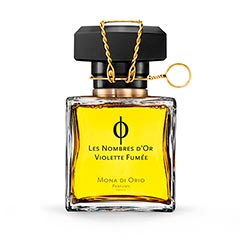
Mona di Orio Parfums Violette Fumée – Timidez a flor de piel

imagen: Mollyhashimoto.com

imagen: Mollyhashimoto.com

Las fragancias (al igual que las personas) más interesantes son aquellas que se dejan descubrir de a poco. Por eso, si buscamos un perfume que nos identifique de algún modo, jamás deberíamos comprar aquel cuyas notas de salida nos cautivaron. Juzgar en base a lo más superficial nos hace perder de vista el verdadero espíritu de la composición, que viene después. Mucho después.

Mi experiencia con Violette Fumée, lanzado en septiembre pasado, reforzó el punto de vista antedicho. Hacía tiempo que había leído sobre él  y quería probarlo (especialmente por su nota de violeta y por la historia detrás: la perfumista Mona di Orio, fallecida en 2011, lo compuso para su socio Jeroen Oude Sogtoen).

Pero Violette Fumée y yo no conectamos inmediatamente. En ese momento me decepcioné porque no concordaba con lo que había imaginado. Lo olí una y otra vez porque sabía que me tenía que gustar. Y no hubo caso: aunque agradable, no me estaba transmitiendo nada. Sin embargo, una muestra se vino conmigo a casa y permitió que esta historia continúe hasta hoy.

La cuestión es que la personalidad de este integrante de la línea Les Nombres d’Or Exclusive no se muestra completamente, de una vez. Primero una conjunción dulce y amigable de lavanda y bergamota se esboza como una tímida sonrisa. Casi a la par, se sonroja con azafrán. La humedad del musgo de roble, entre verde y amaderada, es la que repliega la composición hacia adentro.

Una violeta completa, realzada con rosa turca, abre sus pétalos frágiles, casi translúcidos. Se esconde detrás de un abanico opaco de vetiver y salvia esclarea, brindando una sensación gamuzada. Percibo una violeta acuerada más que ahumada. Y el final tiene una sutileza de opopanax y mirra, envueltos en madera de cachemira (cashmeran o blonde woods, en inglés: un componente sintético que huele suavemente amaderado, dulce y almizclado).

Dándole tiempo para expresarse, entendí que Violette Fumée no está hecho para brillar sino para esos días o momentos en los que queremos tener un perfil bajo. Es una especie de halo liviano y apenas perceptible que se mantiene persistentemente cerca de la piel. Pero atención: no es un perfume para la introspección ni para la meditación,más bien es la timidez hecha perfume.

Virginia

Origen de la muestra: regalo por compra en Luckyscent Scent Bar.

foto: Monadiorio.com

foto: Monadiorio.com

Mona di Orio Parfums Violette Fumée – Lingering shyness on the skin

The most interesting fragrances -much like it happens with people-  are those that are discovered little by little. That is the reason why we should never buy a perfume just because of its captivating head notes. If we are looking for a perfume that we feel identified with, we can’t judge it merely on the surface. We would be missing the authentic spirit of the composition which comes later. Much later.

My experience with Violette Fumée -launched last September- reinforced the above point of view. I had read about it some time before and I was looking forward to trying it (especially because of its violet note and the history behind the fragrance: perfumer Mona di Orio, who passed away in 2011, created it for her business partner Jeroen Oude Sogtoen).

But Violette Fumée and I didn’t connect immediately. At that moment I felt a certain disappointment because it was very different from what I had imagined.  I smelled it again and again, because I had the feeling that I should like it. it was hopeless: although nice, it didn’t convey anything to me. However, I brought a simple home with me letting the story continue until today.

The point is that the personality of this member of  Les Nombres d’Or Exclusive family doesn’t show itself at once. First, a sweet, friendly combination of lavender and bergamot draws a shy smile. Almost simultaneously, it blushes with saffron. The green and woody moisture of oakmoss is what retracts the elements.

A rounded violet, enhanced by Turkish rose, unfolds its fragile (almost translucid) petals. It hides itself behind an opaque fan of vetiver and clary sage, acquiring a sueded finish. I perceive a leathery violet, not a smoky one. The drydown receives the subtlety of opopanax and myrrh, wrapped in  cashmeran (a synthetic ingredient that smells lightly woodsy, sweet and musky ).

Giving it the proper time to express itself, I understood that Violette Fumée is not made to shine but for those days or times when one wants to cultivate a low profile. It’s a kind of lightweight, hardly noticeable halo that remains persistently close to the skin. But beware: it is not a perfume for introspection or meditation, more like shyness transmuted into perfume.

Virginia

Origin of sample: Gift-with-purchase vial obtained at Luckyscent Scent Bar.

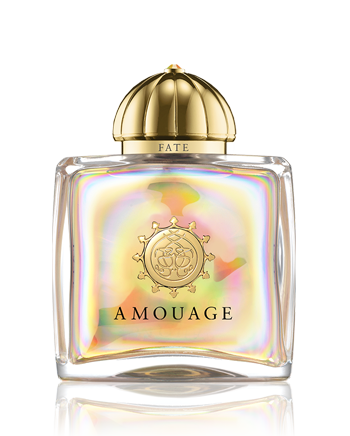
Amouage Fate Woman – Tejido en rayos de sol

imagen: Artseverydayliving.com artista: Caspar David Friedrich "Frau vor der untergehenden Sonne", 1818, Museo Folkwang

imagen: Artseverydayliving.com       artista: Caspar David Friedrich
“Frau vor der untergehenden Sonne”, 1818,   Museo Folkwang

Cuando Sheila, la prolífica escritora tras The Alembicated Genie, se ofreció generosamente a enviarme una muestra de Fate Woman, me sentí eufórica. Mi fetiche con Amouage es un secreto a voces y huelga decir que ansiaba probar el último lanzamiento de la casa omaní.

Como Fate está clasificado bajo la etiqueta de chipre oriental,  esperaba una mezcla oscura, barroca y grandilocuente. Menos operático que otras creaciones de la misma casa y por ende, quizás, con un atractivo más amplio, me impresionó con su levedad. Levedad para los estándares de Amouage, claro. Fate es considerablemente más sustancial y complejo que el 95% de los perfumes que se encuentran actualmente en el mercado.

Fate Woman parece irradiar una luz dorada que hace brillar todo lo que entra en contacto con ella. La salida es dulce y jugosa. Aunque la bergamota está listada entre las notas, me queda una impresión como de naranja dulce. La bergamota/naranja aparece especiada con canela y ají chile, lo que hace la mezcla aún más cálida. Entonces se torna más suave que un suavísimo sweater de cachemira doble. No me impresionó al principio, pero con sucesivos usos, Fate Woman tejió lentamente su red dorada y antes de poder siquiera darme cuenta, ya no logré desenredarme.

El rico corazón floral está entremezclado con incienso y vainillaCuero y castóreo suman una cualidad animal que, lejos de bestial o cruda, resulta tan reconfortante como abrazar a una mascota querida. Fate huele muy clásico y extrañamente familiar pero, al mismo tiempo, innegablemente moderno. Es Romanticismo sin el drama; un parfum de peau al estilo de Amouage.

Este perfume fue compuesto por la talentosa Dorothée Piot (Robertet) -bajo dirección creativa de Christopher Chong– y presentado en 2013. Encuentro su proyección discreta y la longevidad, buena.

Caro

Origen de la muestra: Muestra gentileza de Sheila Eggenberger, The Alembicated Genie

foto: Amouage.com

foto: Amouage.com

Amouage Fate Woman – Woven in sunshine

When Sheila, the prolific writer behind The Alembicated Genie, generously offered to send me a sample of Fate Woman, I was elated. My fetish for  Amouage is no secret and I most certainly wanted to try the latest release from the Omani house.

Since Fate Woman is  classified as an Oriental chypre, I had come to expect a dark and bombastic baroque blend. Less operatic than other creations from the same  house and thus, perhaps, with a wider appeal, it struck me as lightweight. Lightweight by Amouage standards, that is. Fate is considerably more substantial and complex than 95% of the fragrances currently on the market.

Fate Woman seems to radiate a golden light that sets aglow everything that comes in contact with it. The opening is sweet and juicy. Although bergamot is listed among the notes, I am left with an impression of sweet orange. The bergamot/orange is spiced up by cinnamon and chili pepper, what makes the blend even warmer. It then becomes softer than the softest double cashmere sweater. I was unimpressed at first, but with subsequent wearings, Fate Woman slowly wove its golden web around me and before I could even realise it, I was unable to disentangle myself.

The rich floral heart is intermingled with frankincense and vanillaLeather and castoreum add an animalic quality that, far from raw or beastly, is as reassuring as cuddling up with a dear pet. Fate smells very classic and strangely familiar but, at the same time, undeniably modern. It is Romanticism minus the drama; a skin fragrance, Amouage style.

This fragrance was composed by the talented Dorothée Piot (Robertet) -under creative direction of Christopher Chong– and introduced in 2013. I find the projection discreet and its longevity, good.

Caro

Origin of sample: Sample courtesy of Sheila Eggenberger, The Alembicated Genie

Viktoria Minya Hedonist – Nace una estrella

foto: Pierreherme.com

foto: Pierreherme.com

Luego de mucha anticipación, pudimos finalmente probar la opera prima de la perfumista húngara Viktoria Minya. La joven Viktoria se capacitó en el Grasse Institute of Perfumery y trabajó para otras casas antes de crear su propia marca, Parfums Viktoria Minya, en 2011.

Hedonist es un floral frutado (o, mejor dicho, un imponente floral frutado): un floral frutado para adultos, femenino en extremo y no excesivamente joven. Creado a la manera de las grandes composiciones clásicas, nos recuerda esa edad dorada de la perfumería, antes de que la aparición de naditas ozónicas-acuosas invadiera el mercado.

Elegante sin arrogancia, Hedonist rezuma calidad. La botella guarda cuentas de cristal checo amarillo que anuncian luminosidad y calidez. Dulce y de estilo muy francés, el líquido nos evoca apetitosas golosinas. Virginia percibe reminiscencias de amaretti (¿hay heliotropo allí?), mientras que Caro visualiza jugosos duraznos rociados con miel. Después del postre, las flores se abren en todo su esplendor: la luminosa flor de naranjo y el sensual jazmín sambac imprimen su feminidad lasciva a la mezcla. El fondo -todo maderas preciosas y tabaco– presenta una fina textura empolvada, diáfana como organza de seda.

Hedonist es un nombre apto para un perfume tan alegre y festivo: condensa delicias de confitería, las flores más frescas, buen tabaco, licores y lujosas sedas.  El resultado es una fragancia sustancial con excelente longevidad y sillage notable.  Si las próximas creaciones de la Srta. Minya siguen los pasos de Hedonist, es probable que tengamos una nueva estrella.

Caro y Virginia

Origen de la muestra: Muestras cortesía de Parfums Viktoria Minya

foto: Viktoriaminya.com

foto: Viktoriaminya.com

Viktoria Minya Hedonist – A star is born

After much anticipation we were finally able to try the opera prima of Hungarian perfumer Viktoria Minya. The young Viktoria was trained at the Grasse Institute of Perfumery and she worked for other houses before creating her own brand, Parfums Viktoria Minya, in 2011.

Hedonist is a fruity floral or -better put- a grand fruity floral: a fruity floral for grown ups, feminine to the extreme and not excessively young. Created in the manner of the great classical compositions, it reminds us of the golden age of perfumery, long before ozonic-watery-nothings invaded the market.

Elegant though not conceited, Hedonist oozes quality. The bottle contains yellow Czech crystal beads which seem to announce luminosity and warmth. Sweet and very French in style, the juice evokes mouthwatering treats. Virginia finds it reminiscent of amaretti biscotti (is there heliotrope in here?), while Caro envisions juicy peaches drizzled with honey. After dessert, the flowers bloom in full glory: luminous orange blossom and sensual jasmine sambac imprint their feminine lasciviousness to the blend. The drydown -all about precious woods and tobacco– presents a fine powdery texture, as sheer as silk organza.

Hedonist is a fitting name for a perfume  this  joyful and celebratory: it condenses confectionery delights, the freshest flowers, fine tobacco, liquors and luxurious silks. The result is a substantial fragrance with excellent longevity and notable sillage.  If Ms. Minya‘s next creations follow in the steps of Hedonist, it is likely we will have a new star .

Caro & Virginia

Origin of sample: Samples courtesy of Parfums Viktoria Minya

foto: Justballet.co.uk

foto: Justballet.co.uk