Jovoy Paris Rouge Assassin – Lápiz labial rosado

imagen: Hprints.com   ilustrador: Chéri Herouard para La Vie Parisienne, 1919

imagen: Hprints.com     ilustrador: Chéri Herouard   (La Vie Parisienne, 1919)

Jovoy es una perfumería establecida en París que abrió sus puertas por primera vez en 1923; fue reabierta en 2010 y hoy ofrece una amplísima gama de fragancias para conocedores, entre ellas su propia marca. Conocí Rouge Assassin durante un viaje. En aquel momento tenía tal resfrío que todavía me pregunto cómo logré percibir sus delicadas notas y conservar el recuerdo. Grande fue mi alegría cuando Virginia, de paso en Buenos Aires,  trajo consigo una botella.

Rouge Assassin fue compuesto por Amélie Bourgeois (Flair). Según Jovoy: “Dos tipos de mujeres de los años veinte se cruzan en el mismo espacio sin conocerse jamás:  Una es ‘la maitresse de ces messieurs’, una amante según la tradición del Segundo Imperio (estas elegantes mujeres mantenidas se contaban entre las primeras clientas de Jovoy) y la “garçonne”, un término para la mujer emancipada, cuyo aspecto podrá haber sido por momentos andrógino, pero que fue la primera en la historia de la moda femenina en revelar sus piernas. Pronto los brassieres  reemplazarían a los corsets. Las medias gruesas desaparecieron en favor de otras de seda, que se lucían enrolladas sobre una liga por encima de las rodillas. Fue en esta época que aparecieron los primeros lápices labiales.  Rouge Assassin rinde tributo a esas mujeres temerarias e imparables que subvirtieron el orden establecido y rompieron todas las reglas.”

Rouge Assassin -a pesar de su nombre- no resulta oscuro, salvaje ni agresivo. Quizás un exceso de fragancias animales y operáticas me haya echado a perder,   pero me aventuraría a describirlo como inocente. Este es un coqueto floral almizclado que flota alrededor del usuario y murmura con suavidad; demasiada suavidad a menos que recuerde aplicarlo en abundancia. Parece más evocador de las pálidas damas de la Belle Époque que de las independientes  flappers de los 1920s: no hay alusiones al Orientalismo, no hay maderas exóticas, no hay tabaco.

Me gusta leer a Rouge Assassin como un relato olfativo sobre la transición que hicieron las mujeres en los primeros años del siglo XX: un floral atalcado suave (rosa, iris, polvos de arroz) es atravesado por un trazo de lápiz labial sutil pero definido que le presta una textura cerosa. La sensación general,más moderna que histórica o retro, es realzada por almizcles blancos y maderas lustradas. Estas últimas le confieren una cierta profundidad; si bien no lo oscurecen demasiado.

En resumen, en lugar del arma letal que el nombre insinúa, encuentro un eau de parfum delicadamente sugestivo, incluso lúdico. Su sillage es discreto y la longevidad, excelente. Recomiendo una aplicación pródiga a fin de poder apreciar mejor sus matices.

Caro

Origen de la muestra: Botella comprada en Scent Bar, L.A.

Gaia Fishler, de The Non Blonde lo describe como pleno y seductor. Si quieren leer sus impresiones, pueden encontrarlas aquí. 
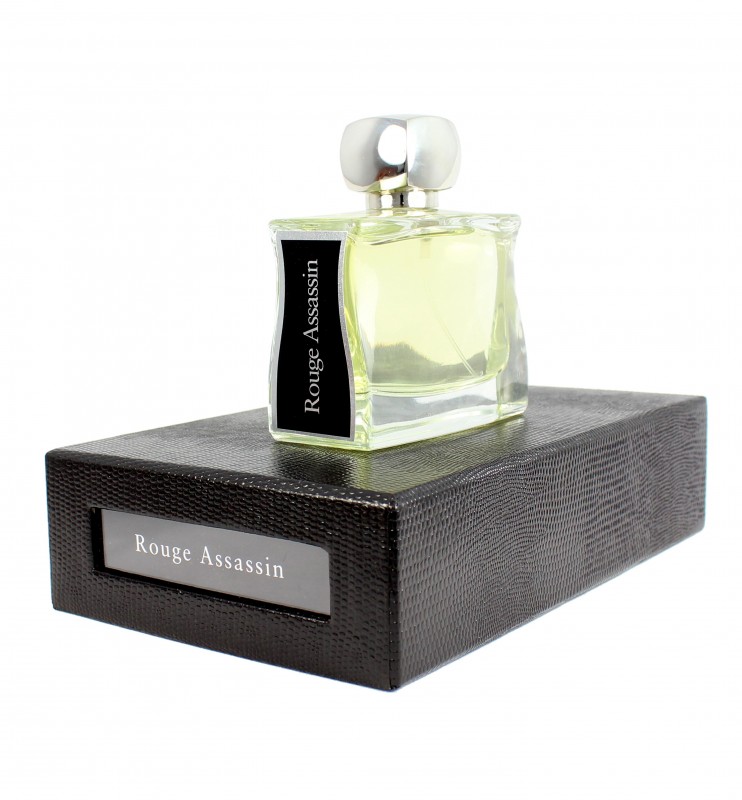
foto: Jovoyparis.com

foto: Jovoyparis.com

Jovoy Paris Rouge Assassin – Pink lipstick

Jovoy is a Paris based perfumery which opened its doors for the first time in 1923; restored in 2010, it now offers a vast array of fragrances for connoisseurs, among these, their own namesake brand. I first came across Rouge Assassin during a trip. I had such a terrible cold at the time, I wonder how I ever managed to perceive its delicate notes and keep their memory with me. Great was my joy when Virginia  brought a bottle along with her on her recent visit.

Rouge Assassin was composed by Amélie Bourgeois (Flair). According to Jovoy: “Two types of women from the Twenties mingle in the same space without ever really meeting:  One is ‘la maitresse de ces messieurs’, a mistress in the tradition of the Second Empire (such chic kept women were among Jovoy’s first clients) and  the “garçonne”, a term for the emancipated woman, whose look may have been androgynous at times, but who was the first in the history of women’s fashion to reveal her legs. Soon, brassieres would replace corsets. Thick stockings vanished in favor of silk ones worn rolled over a garter above the knee. It was at this time that the first lipsticks appeared.  Rouge Assassin pays tribute to those fearless, unstoppable women who upended the established order and broke all the rules.”

Rouge Assassin -despite its name- is not dark, wild or aggressive. I might have been spoiled by excessively operatic and animalic fragrances, but I would go far and describe it as innocent. This is a coquettish musky floral that floats around the wearer and whispers softly; too softly if don’t remember to spritz prodigally. It appears more evocative of the pale ladies of the Belle Époque than the  independent flappers of the 1920s: there are no allusions to Orientalism, no exotic woods, no tobacco.

I like to read Rouge Assassin as an olfactory tale of the transition women underwent in the early years of the XX century: a soft powdery floral (rose, iris, rice powder) becomes pierced by a subtle but definite stroke of lipstick which lends a waxy texture. The overall feel, more modern than historic or retro, is enhanced by white musks and waxed woods.The latter lend a certain depth but do not darken the composition.

All in all, instead of the lethal weapon its name implies, I find a softly suggestive, even playful, eau de parfum. Sillage is discreet and longevity excellent. I encourage prodigal application in order to better appreciate all its nuances.

Caro

Origin of sample: Bottle purchased at Scent Bar, L.A.
Gaia Fishler, from The Non Blonde describes it as full bodied and seductive. You might like to read her impressions too.

Perfumería – Pequeña autobiografía olfativa

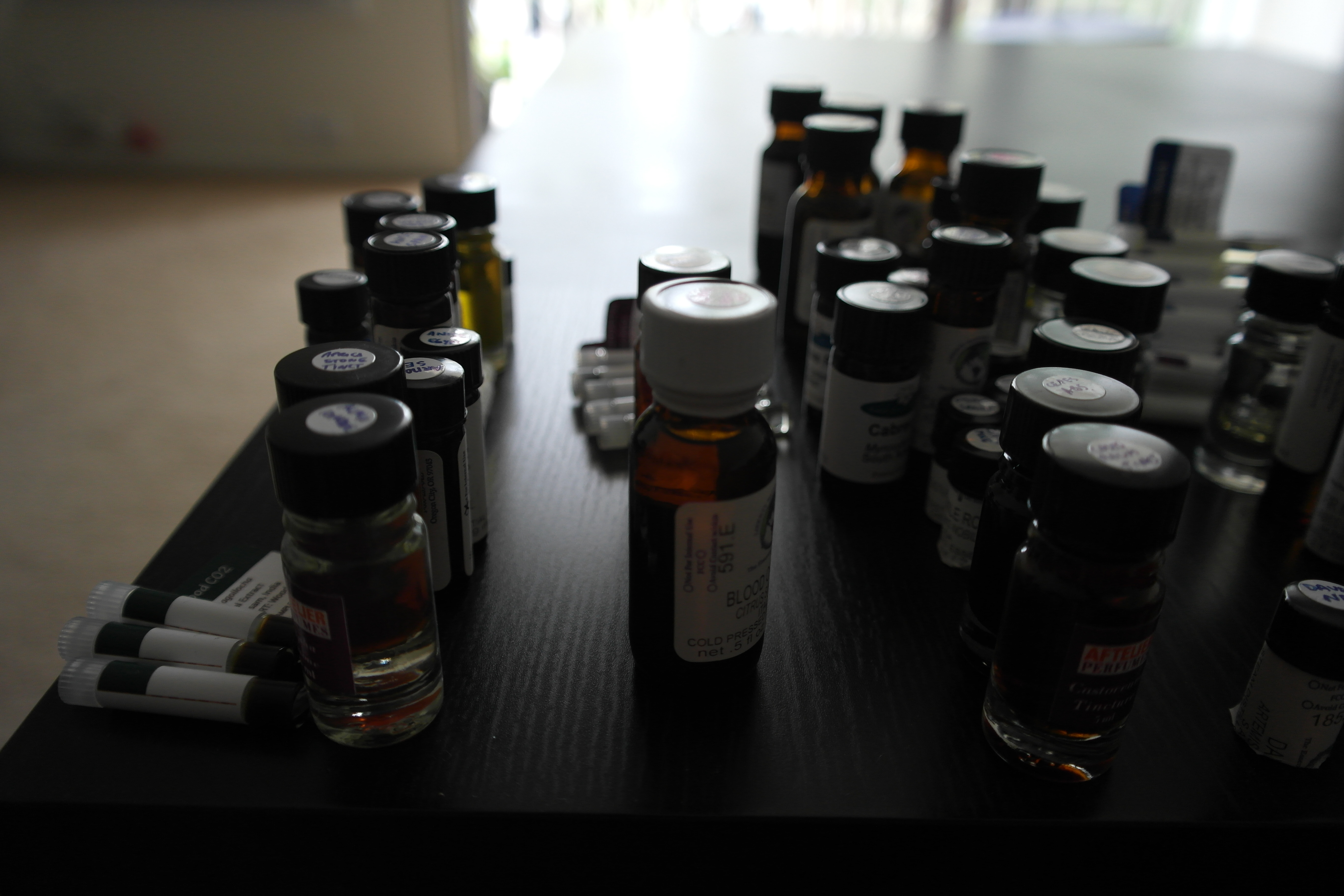
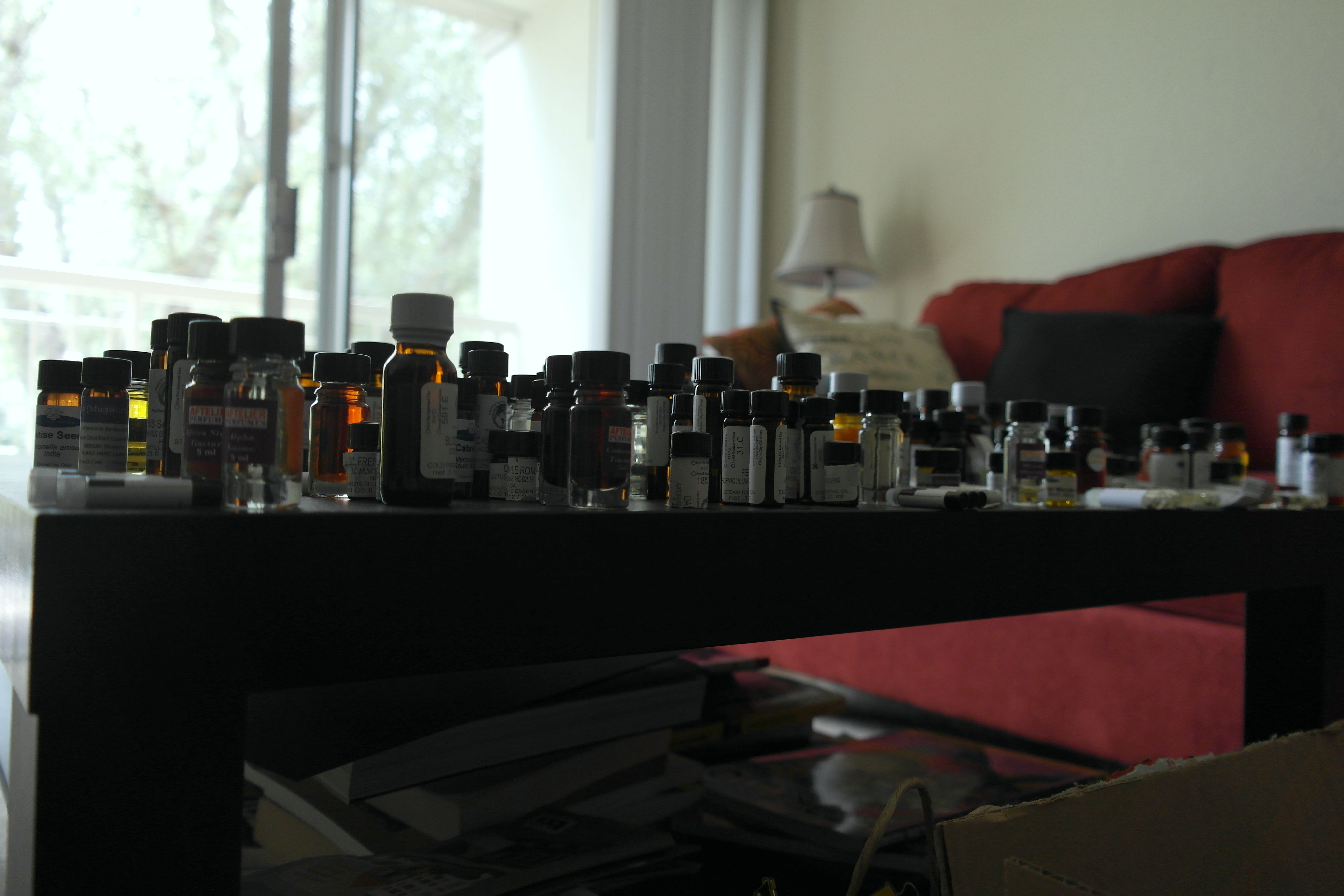
foto: Virginia Blanco  Clasificando materias primas de estudio.

foto: Virginia Blanco     Clasificando materias primas de estudio

Mis padres siempre repiten las mismas historias en las que, teniendo yo no más de tres años, era capaz de identificar por el olfato lo que alguien acababa de comer o incluso relacionaba a personas con olores. Pasaron años de ir por la vida oliendo cosas y desarrollando activamente una memoria olfativa. Ya adolescente, sólo sabía que me gustaban los perfumes con locura.

Recién en el 2010 tuve la oportunidad de experimentar por vez primera con algunas esencias. Quedé impactada. Al año siguiente, realicé un curso intensivo de Perfumería. Allí tuve un panorama muy amplio de las familias olfativas y de los perfiles de los ingredientes (naturales y sintéticos) más importantes de cada una. Sin embargo, no me fue suficiente.

Desde ese momento fuí percibiendo que mi aproximación a las fragancias iba cambiando. Fue como si, luego de años de simplemente escuchar música, ahora empezara a familiarizarme con cada instrumento, su personalidad, el “color” de sus notas… El disfrute de cualquier composición ya no sería el mismo.

Como ya lo he mencionado otras veces, al venirme a vivir a los Estados Unidos en el 2012 decidí estudiar Perfumería Natural: otra dimensión creativa se abrió ante mis narices. Nuevos matices, nuevas combinaciones y estructuras olfativas se fueron desplegando a mi alrededor. Todo eso sumado a las charlas con perfumistas independientes y el conocer sus obras, fueron algunas de las cosas más estimulantes que he vivido.

La inquietud por la perfumería me llevó a querer entenderla desde sus ingredientes, que no son infinitos pero sí unos cuantos miles. Esta apasionada (y demandante) labor no sólo desemboca en una mayor comprensión de los perfumes  en sí sino también en una alta estima por el trabajo del perfumista.

A veces siento que estoy aprendiendo música, a veces pintura, otras un nuevo idioma. ¿Será una mezcla de los tres?

Virginia

foto: Virginia Blanco  Material de estudio.

foto: Virginia Blanco        Haciendo ejercicios de memoria olfativa.

Perfumery – A Little Olfactory Autobiography 

My parents tells me the same stories again and again. When I was barely three, I was able to identify whatever somebody have just finished eating just by its smell; I even used to link persons with smells. Years went by and I went through life sniffing things and actively developing an olfactive memory. As a teenager, I only knew that I was mad about perfumes.

In 2010 I had my first chance to experiment with some essences, which had a strong impact on me.The following year I took an intensive Perfumery course where I had a very broad view of olfactive families and the most important profiles of synthetic and natural ingredients of each. It wasn’t, however, enough to me.

It was then that I realized my approach to fragrances was changing. It felt as if, after many years of just listening to music, now I could learn about each instrument, its personality, the “color” of its notes… The enjoyment of fragrant compositions would not be the same anymore.

As I’ve mentioned on other occasions, I decided to start Natural Perfumery studies in 2012, when I came to the U.S.: another creative dimension appears before my nose. New hues, new olfactive combinations and structures unfolded around me.  All this, along with having conversations with independent perfumers and getting to know their creations were one of the most stimulant things that I have experienced.

The newly awaken interest for Perfumery led me to incorporate more knowledge, starting from the ingredients which, although not infinite, consist of a few thousands. This passionate (but extenuate and demanding) labor not only brings me a better understanding of perfume itself but also a higher regard towards the perfumers’ work.

Many times I feel as I’m learning music, sometimes like painting, other times it is like a new language. Wouldn’t it be a mix of all three?

Virginia

foto: Virginia Blanco

foto: Virginia Blanco

foto: Virginia Blanco

foto: Virginia Blanco

foto: Emmanuel Oga

foto: Emmanuel Oga

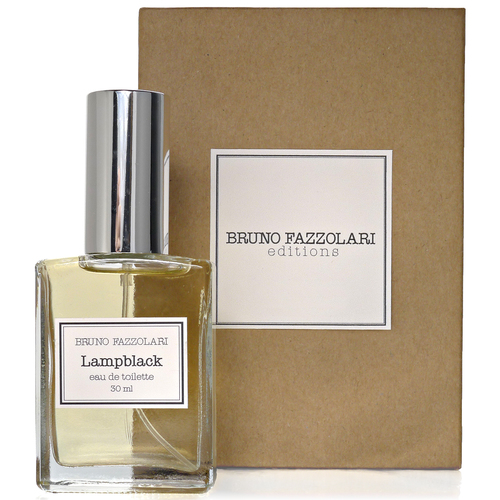
Bruno Fazzolari Editions Lampblack – Píntalo de negro

foto: Publicdomainpictures.net  PH: Petr Kratochvil

foto: Publicdomainpictures.net    Photo: Petr Kratochvil

Bruno Fazzolari es un pintor, perfumista, escritor y maestro que vive en San Francisco. Ha estado trabajando con perfumes en su estudio durante una década, presentándolos junto a sus obras plásticas para ofrecer otra dimensión sensitiva a la exhibición. Sin embargo, recién el año pasado lanzó su colección de fragancias.

Mi nariz fue cautivada por sus creaciones dos veces. La primera fue en marzo del 2013 en el  SF Artisan Fragrance Salon, donde pude oler casi todos sus perfumes y quedé sorprendida ante tan agradable orquestación de los ingredientes. La segunda vez fue hace casi un mes atrás. Me encontraba haciendo las valijas para ir a la  Argentina de visita, cuando recibí material de prensa y una muestra de Lampblack. Decidí llevármela conmigo de viaje.

Cuando probé este eau de toilette sobre la piel, sentí como si cayera en un oscuro abismo de recuerdos. Las brillantes y enceguecedoras notas de salida son una explosión de pomelo y naranja dulce que levantan el contraste perfecto para la oscuridad que vendrá a continuación.

La descripción adjunta habla de “Notas ahumadas que recuerdan a la tinta o a la brea”. Podría ser, pero mi cabeza me llevó por otro lado. Cierro los ojos y el  vetiver,el benjuí y la pimienta negra me dibujan un carbón perfumado sin ninguna sensación grasosa o espesa. Es tiznado, con trazos de papel quemado que nunca llega a ser agobiante.

Cuando pasamos unos minutos en un cuarto oscuro, el ojo se acostumbra a la falta de luz y al cabo de un rato comienza a distinguir los objetos que nos rodean. Bien, es una experiencia muy similar aquí. Se perciben matices amaderados, florales y balsámicos -¡hasta incluso destellos como los de los cristales!- dentro del delicadamente ahumado Lampblack. Es como dice la canción: “Black as night, black as coal”

Virginia

Origen de la muestra: Cortesía de Bruno Fazzolari.

foto: Cortesía de Bruno Fazzolari

foto: Cortesía de Bruno Fazzolari

Bruno Fazzolari Editions Lampblack – Paint it black

Bruno Fazzolari is a San Francisco based painter, perfumer, writer and teacher. He has been working in scents for a decade showing them alongside his exhibitions as another sensitive dimension of the paintings but last year he finally launched his fragrance collection.

My nose was captivated by his perfumes twice. First time at the SF Artisan Fragrance Salon last year, I could smell almost every one of his creations and was surprised at such agreeable orchestration. The second one was barely a month ago. I was packing my suitcases to go to Argentina to visit family and friends when I received a press release with a Lampblack sample. It came with me.

I have tried this eau de toilette on the skin and it felt like falling into a dark hole of memories. Its brilliant and blinding top notes of bitter grapefruit and sweet orange achieves a contrast with the smokiness that follows.

The description attached says “Smoky notes that recall ink or tar”. Could be, but my mind goes in other direction. I close my eyes and vetiver, benzoin and black pepper draw perfumed charcoal without any greasy sensation or thickness. It is sooty with hints of burnt paper but never overwhelming.

When one spends a while into a dark room her eyes become able to distinguish objects. Well, is a similar experience here. There are woody, florals and balsamic hues -even lights that flash like crystals! – into the delicate smokiness of Lampblack.  Like the songs goes: “Black as night, black as coal”

Virginia

Origin of sample: Vial courtesy of Bruno Fazzolari.

imagen: Cortesía de Bruno Fazzolari  obra: Lampblack (201), 2012, tinta sobre papel.  artista: Bruno Fazzolari

imagen: Cortesía de Bruno Fazzolari   artista: Bruno Fazzolari “Lampblack (201)” tinta sobre papel, 2012

Vero Profumo Mito (voile d’extrait) – Curvas peligrosas

imagen: Commons.wikimedia.org artista: Willem van Aelst  "Naturaleza muerta con ratón", 1674

imagen: Commons.wikimedia.org    artista: Willem van Aelst    “Naturaleza muerta con ratón”, 1674

En 2013, la perfumista suiza Vero Kern lanzó una nueva concentración para sus cuatro fragancias (Kiki, Rubj, Onda y Mito): voile d’extrait, equivalente en potencia a un eau de parfum. La fórmula es en este caso  similar a la de sus extractos.  Debe notarse que las eaux de parfum de la línea Vero Profumo consisten en una fórmula diferente y la mayoría de ellas presenta una nota característica de  fruta de la pasión (maracuyá).

Los voiles d’extrait resultan ideales para quienes encuentran engorroso el ritual de aplicar su perfume con la tapita del frasco. Me complace reportar que la concentración más ligera no va en detrimento de su sustancialidad: los voiles se sienten menos compactos pero aun así potentes. Debido a esta menor densidad resulta mucho más fácil apreciar las distintas notas en ellos que en los extraits.

Mito voile d’extrait vuelve a trabajar el motivo de los jardines de la Villa d’Este y mantiene el burbujeo del eau de parfum original. Luego de la salida -alimonada, jugosa- se nutre de una abundante dosis de tuberosa y durazno (aquí pueden apreciarse con facilidad los aspectos gomosos de un absoluto de tuberosa excepcional). El verdor musgoso ofrece un fondo de terciopelo oscuro para las flores y frutas. En consecuencia, aunque  tan umbrío como su predecesor, se vuelve mucho más carnoso, curvilíneo. Si Mito EdP podía apagar la sed con su amargor efervescente, Mito VdE, en cambio, abre el apetito e invita a morder. La fragancia hace un guiño a los magníficos chipres de antaño a través de la cualidad chispeante de Cristalle, la madurez de Femme (vintage) y la oscuridad de Mitsouko, pero tiene su propia identidad. La sensación atemporal y el erotismo presentes en todas las creaciones de la Srta. Kern brillan en esta joyita.

Caro

Origen de la muestra: Muestra gentileza de Campomarzio 70

Pueden leer nuestra reseña de Mito eau de parfum aquí

foto: Bloomperfume.co.uk

foto: Bloomperfume.co.uk

Vero Profumo Mito (voile d’extrait) –  Dangerous curves

In 2013 Swiss nose Vero Kern launched a new concentration for her four fragrances (Kiki, Rubj, Onda and Mito): voile d’extrait, equivalent in strength to eau de parfum. The formula, in this case, is similar to that of her extraits.  One must note that the eaux de parfum in the Vero Profumo range consist of a different formula  and most of them boast a characteristic  passionfruit note.

The voiles d’extrait are  ideal for those who are not too fond of the ritual of dabbing. I am happy to report that the lighter concentration doesn’t detract from their substantiality: the voiles feel less compact though still potent. Due to this lesser density, it becomes much easier to appreciate the different notes in them than in the extraits.

Mito voile d’extrait reworks the motif of the Villa d’Este gardens and retains the bubbliness of the original eau de parfum. After the opening –  lemony, juicy it is fed a generous dose of tuberose and peach (the rubbery aspects of an outstanding tuberose absolute can be easily appreciated here). The mossy greenness provides a dark velvety backdrop for the fruits and flowers. In consequence, and although it remains as shady as its predecessor, it becomes much fleshier, curvier. If Mito EdP could quench one’s thirst with its effervescent bitterness, Mito VdE  whets one’s appetite and invites to take a bite. The fragrance nods at the magnificent chypres of yore through the sparkling quality of Cristalle, the ripeness of (vintage) Femme and the darkness of Mitsouko, but it has its own identity. The timeless feel and eroticism present in all of Ms. Kern‘s creations shine in this jewel of a fragrance.

Caro

Origin of sample: Sample courtesy of Campomarzio 70

You may read our thoughts on Mito eau de parfum here

imagen: Commons.wikimedia.org artista: Willem van Aelst  "Naturaleza muerta con canasto de frutos en un estante de mármol", 1650

imagen: Commons.wikimedia.org       artista: Willem van Aelst      “Naturaleza muerta con canasto de frutos en un estante de mármol”, 1650

Amouage Ubar – Joie de vivre

imagen: Vintageadbrowser.com

imagen: Vintageadbrowser.com

Existen unos pocos -muy pocos- perfumes que siempre logran inundarme de alegría. De hecho sonreí ante la sola idea de reseñar Ubar, ya que eso me daría la excusa perfecta para marinarme en él durante el transcurso de varios días.

Lanzado originalmente por Amouage en 1995, fue discontinuado y relanzado en 2009 bajo una fórmula diferente. La fragancia lleva el nombre de una legendaria ciudad árabe perdida bajo la arena. En modo alguno exótico, Ubar (en su versión actual) huele muy muy clásico y muy muy francés. La alusión a las arenas del desierto es, sin embargo, evidente en la botella, cuya pintura dorada se desvanece hacia la parte superior.

Ubar es una explosión floral. La salida centellea con mandarina y con el olor característico -frutado, alimonado- de la Litsea Cubeba (May Chang). La impresión inicial es crujiente, ligeramente verde, casi punzante. Una nota vívida y esplendente de rosa damascena pronto endulza el verdor, pero la verdadera estrella de la composición es el lirio del valle. Su aparición parece fundir juntas todas las demás flores de este bouquet blanco (fresias, jazmines, azahares, tuberosa) volviéndolas más cremosas. El lirio del valle pierde su consabida condición virginal y se deja corromper por una lasciva civeta. El genio de Ubar reside en este aspecto animal del lirio del valle y en el hecho de que la mezcla conserva su frescura en medio de la opulencia descarada.

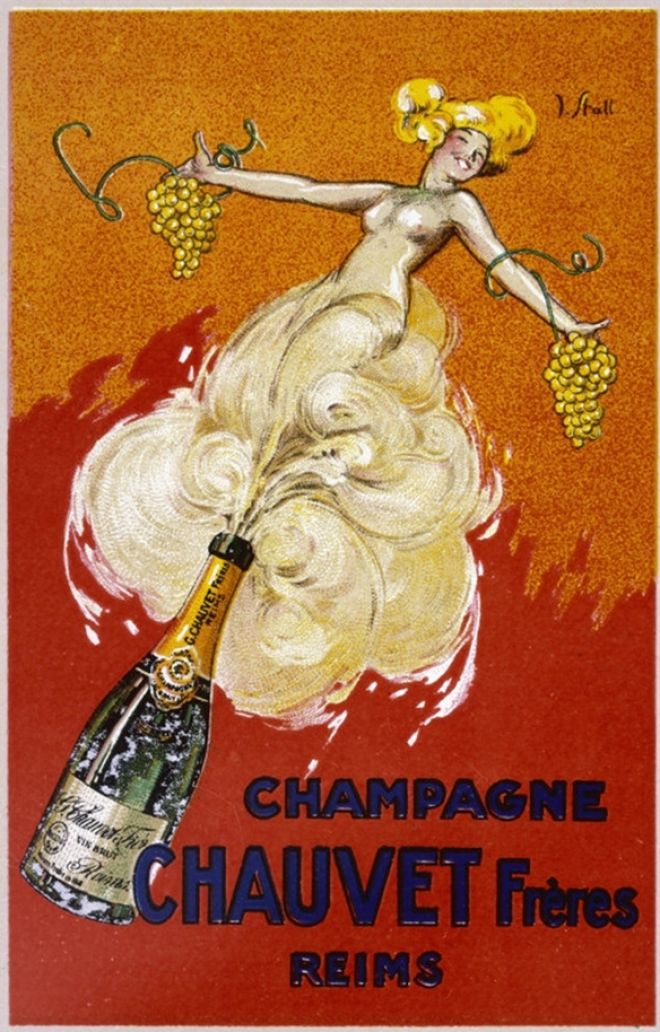
La mélange resultante es el equivalente olfativo a tomar una (o dos, o tres) copas de champagne: burbujeante, efervescente, alegre. Ubar demuestra proyección y longevidad excelentes. Se siente embriagador, festivo y  -oh, claro que sí- tiene segundas intenciones.

Caro

Origin of sample: bottle purchased at MiN New York

foto: Amouage.com

foto: Amouage.com

Amouage Ubar – Joie de vivre

There are a few -very few-  fragrances that never fail to suffuse me with joy. In fact, I beamed at the mere idea of reviewing Ubar, as that would give me the perfect excuse to marinate in it over the course of some days.

Originally launched by Amouage in 1995, it became discontinued and relaunched 2009 under a different formula. The fragrance bears the name of a legendary Arabian city which was lost under the sands. Not exotic by any means, current Ubar smells very very classic and very very French. The allusion to the sands of the desert is evident, however, on the  bottle whose pale gold paint fades toward the top.

Ubar is a floral explosion. The opening sparkles with tangerine and the characteristic smell -fruity, lemony- of Litsea Cubeba (May Chang). The initial impression is crisp, slightly green, almost sharp. A splendid, nitid  rosa damascena note soon sweetens the greenness, but the true star of the composition is lily of the valley. Its appearance seems to meld together all the other flowers in this white bouquet (freesia, jasmine, orange blossom)  rendering them creamier. The lily of the valley loses its usual virginal  condition  as it becomes corrupted by a lascivious civet; the genius of Ubar resides in this animalic lily of the valley and in the fact that the blend retains its freshness amidst the unabashed opulence.

The resulting mélange is the olfactory equivalent to drinking  one (or two, or three) glasses of champagne: bubbly, effervescent, cheerful. Ubar boasts excellent projection and longevity. It feels inebriating, festive and -oh, yes- it does have second intentions.

Caro

Origin of sample: bottle purchased at MiN New York

foto: Jewelsdujour.com

foto: Jewelsdujour.com