Vero Profumo Kiki – Lavanda cristalizada

foto: Herbcompanion.com

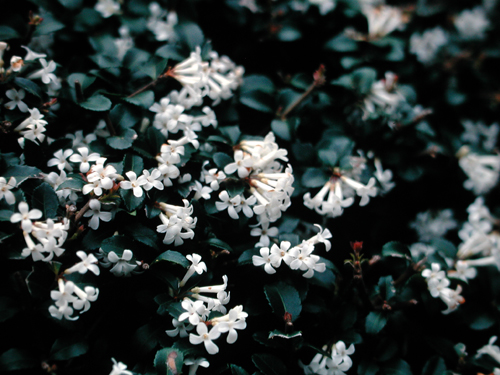
La mayoría de las veces son los perfumes los que nos eligen a nosotros y no a la inversa. Estaba ansiosa por conocer a Vero Kern e igualmente ansiosa por probar su exuberante floral blanco Rubj. Quizás mi ansiedad estaba algo fuera de control ese día y  necesitaba seriamente de los poderes calmantes de la  lavanda (la planta tiene propiedades  sedantes, relajantes y antidepresivas)  porque fue Kiki -un homenaje “lavanda-céntrico” a París– el que me cautivó.

Antes de crear su línea, Vero Profumo, la inspiradora Vero era aromatóloga. En sus tres fragancias –Rubj, Onda Kiki–  interpreta magistralmente los acordes dominantes (flores blancascuero y lavanda respectivamente) y los ejecuta de manera sublime.

En Kiki (extracto) la salida huele como…bueno… lavanda, brillante y con el amargor herbáceo característico de la planta. La lavanda aparenta ser algo cruda y falta de refinamiento; como la flor, el tallo y las hojas, todo junto, pero esta impresión dura sólo unos instantes. La mejor parte está por venir.

Si bien la  lavanda brinda una identidad fuerte al perfume y está presente a lo largo de la evolución, recibe un elegante tratamiento: se siente suave y aterciopelada. La mezcla se torna más dulce y atalcada a medida que la fragancia evoluciona. Esta etapa es reconfortante y ligeramente gourmand: la lavanda parece recubierta de azúcar y aun así percibo en ella una cualidad lactónica. Si bien la salida se vislumbraba aromaterapéutica, el fondo es íntimo, sutil y  almizcladoKiki logra conservar todas las virtudes de la lavanda tras una apariencia refinada.

Aunque admiro el alegre encanto de Rubj y el innegable sex-appeal de Onda,  probablemente mi primera botella sea el dulce y reconfortante Kiki, que sugiere y sorprende, como lencería de seda bajo jeans y una camiseta.

Caro

Origen de la muestra: muestra gentileza de Vero Profumo
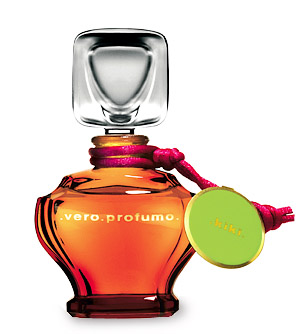
foto: Luckyscent.com

Vero Profumo Kiki – Crystallised Lavender

Most of the time it is fragrances that choose us and not the other way round. I was anxious to meet Vero Kern and equally anxious to sniff her exuberant white floral Rubj. Perhaps my anxiety went out of control  that day and I was in serious need of the soothing powers of lavender (the plant has  sedative, relaxing and antidepressant  properties) because it was Kiki -a lavender-centric homage to Paris– the one that captivated me.

Before creating her line, Vero Profumo, the inspiring Vero was an aromatologist. In her three fragrances –Rubj, Onda and Kiki–  she masterfully interprets the dominant accords (respectively white flowers, leather and lavender) and executes them in a sublime way.

In Kiki (extrait) the opening smells like…well… lavender, bright and with the herbaceous bitterness characteristic of the plant. The lavender seems a bit raw and unrefined; like flower, stem and leaves all together, but this impression lasts only for a few seconds. The best part is about to come.

Although lavender gives a strong identity to the perfume and is present throughout the evolution, it undergoes an elegant treatment: it feels soft and velvety. The blend gets sweeter and more powdery as the fragrance evolves. This stage is comforting and slightly gourmandish: the lavender seems dipped in sugar, yet I  perceive there’s also something lactonic about it. If the opening seemed a bit aromatherapeutical, the drydown is subtle, intimate and  musky. Kiki manages to mantain all the virtues of lavender under a refined guise.

While I admire Rubj‘s joyful charm and Onda‘s undeniable sex appeal, my first bottle will probably be the sweet and comforting Kiki, which suggests and surprises like silk lingerie under jeans and a tee.

Caro

Origin of sample: Sample courtesy of Vero Profumo

Lorenzo Villoresi – El alquimista

foto: Gentileza Lorenzo Villoresi

Los italianos en general y los florentinos en particular saben una cosita o dos sobre belleza y armonía. Lorenzo Villoresi ha estado creando perfumes desde 1981. En 1990 el hobby, que había sido inspirado por sus viajes a Medio Oriente, dio lugar a la casa que conocemos hoy. Independiente y autodidacta, Villoresi fue laureado con el Prix Francois Coty en 2006.

Las fragancias de Villoresi poseen una cualidad clásica y familiar y sin embargo parecen recubiertas de un aura mística. Sus creaciones son sensuales: inocentemente como el delicado floral Iperborea, o de manera más cruda, como el irresistible Musk; incluso el marino Aura Maris y el verde Yerbamate  se ven infundidos de una sutil carnalidad. No entraré en detalles acerca de los productos corporales, la calidad de los cuales encuentro sobresaliente.  

Lorenzo Villoresi también crea fragancias personalizadas (el equivalente  haute couture a la colección “prêt-à-porter“) y planea inaugurar un atelier interactivo, dedicado a esencias y perfumes, en su Florencia natal.

Logramos hacerle algunas preguntas al maestro:

-¿Cree que hay una identidad italiana o, más espécíficamente,  florentina en sus perfumes?

No lo creo, porque ninguno de ellos ha sido inspirado por un tema florentino. Nos sentimos y nos gusta ser internacionales bajo un punto de vista cultural; no nos identificamos con ningún estilo o período histórico. Nuestras fragancias pertenecen a diferentes culturas, mitos y leyendas de distintos países y épocas. Quizás la nueva fragancia que recién lanzamos, Aura Maris de la colección  Mare Nostrum es más “italiana”, porque está relacionada con el mar Mediterráneo. ¡Pero el Mediterráneo no es solamente italiano! ¡Así que podríamos decir que Aura Maris, igual que Piper Nigrum, es “antiguo Romano-Italiano”!
-¿A qué huele Florencia para usted?

La Florencia sublimada, la Florencia de mis sueños y recuerdos, huele a flores de primavera de las colinas que rodean la ciudad, a los árboles de magnolia y las glicinas de los jardines escondidos; a las especias y hierbas de los viejos mercados y a los olores de las distintas actividades de los artesanos.

 
-¿Qué involucra su idea de elegancia?
L a elegancia es no seguir ninguna tendencia de moda y, cuando es posible, crear prendas, zapatos o accesorios a medida. Incluso los más sencillos. Por ejemplo, si quiero una camisa verde y no encuentro ninguna cómo la que me gustaría, debería buscar la tela y mandarla a hacer por un sastre, sin preocuparme en absoluto si está de moda o no. Tal como la imagino. Hay una frase famosa de Emilio Pucci que dice “¿El estilista? El comienzo del fin del estilo”.

-¿A qué apunta cuando crea una nueva fragancia?

Intento crear una dimensión muy especial, con extraordinarias visiones, sentimientos, sensualidad y emociones.

-Sus creaciones son innegablemente bellas ¿Cuán importante es crear belleza?

Gracias por el elogio! La belleza es importante porque hace bien a los ojos y al corazón. La belleza también representa una suerte de “estrella polar”, un sueño, un deseo muy elevado y de esta manera indica una especie de  “camino del arcoiris”, un “puente” hacia el paraíso y el infinito.

-¿Qué aroma le gustaría recrear en forma líquida?

El aroma del desierto y del placer y libertad que siento cuando estoy allí solo, día y noche!

-¿Cuál le gustaría que fuera su legado?

Ser bueno y crear más y más cosas buenas y bellas.

Caro

foto: gentileza Lorenzo Villoresi

Lorenzo Villoresi – The alchemist

Italians in general and Florentines in particular know a thing or two about beauty and harmony. Lorenzo Villoresi has been creating artistic perfumes since 1981. In 1990 his hobby, which had been inspired by his trips to the Middle East, gave way to the house we know today. Independent and self taught, Villoresi was awarded with the Prix Francois Coty in 2006.

 Villoresi‘s fragrances possess a classic and familiar quality, yet there’s an aura of otherworldliness to them. His creations are sensual: innocently so, like the delicate floral Iperborea, or in a raw way, like the irresistible Musk; even the marine   Aura Maris and the green Yerbamate feel infused with a subtle carnality. I will not even get into detail about the body products, the quality of which I find outstanding.  

Lorenzo Villoresi also creates personalised fragrances (the haute couture equivalent to the “prêt-à-porter” collection) and is planning to open an interactive atelier, dedicated to essences and perfumes, in his native Florence.

We managed to ask the master a few questions:

-Do you think there’s an Italian or, more specifically,  Florentine identity to your fragrances?

I don’t think so, also because none of them is inspired by a Florentine theme. We feel and like to be international under a cultural point of view; we do not identify with any style or historical period. Our fragrances belong to different cultures, myths and legends of different countries and times. Maybe the new fragrance that just came out, Aura Maris of the Mare Nostrum collection is more “Italian”, because it is related to the Mediterranean sea. But the Mediterranean sea is not only Italian! So we could say that Aura Maris, like Piper Nigrum, are “ancient Italian-Roman”!
-What does Florence smell like to you?

The sublimated Florence, the Florence of my dreams and memories, smells like spring flowers from the hills around the city, like the magnolia trees and the wisteria from the hidden gardens; like the spices and the herbs of the old markets and like the smells of the different activities  of the craftsmen.

 
-What does your idea of elegance entail?
Elegance is not to follow any fashion trend and where possible to create custom made clothes, shoes, accessories, etc. Even simple ones. For example if I feel like wishing, a green shirt and I don’t find one the way I like it,  I should try to find the tissue and have it made by a tailor, completely without worrying if it is fashionable or not.  Just the way I imagine it. There is a famous sentence of Emilio Pucci who said “The Stylist? The beginning of the end of style”.

-What do you aim for when you create a new fragrance?

I aim to create a very special dimension with extraordinary visions, feelings, sensuality and emotions.

-Your creations are undeniably beautiful. How important is to create beauty?

Thank you for the compliment! Beauty is important, because it does good to the eyes and to the heart. Beauty also represents a sort of “polar star”, a dream, a very high wish and in this way it indicates a sort of “rainbow way”, a “bridge” towards paradise and the infinite.

-What scent would you like to be able to re-create in liquid form?

The scent of the desert and of the pleasure and freedom that I feel when I am there alone, night and day!

-What would you want your legacy to be?

To be good and to create more and more good and beautiful things.

Caro

Letras Perfumadas – “Soneto XVII” de Pablo Neruda por Olympic Orchids

foto: Greatplantpicks.org

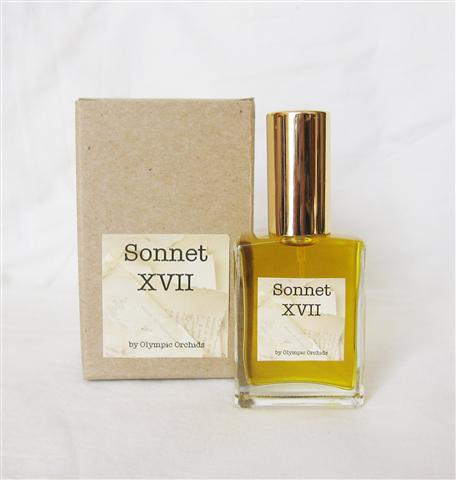
Se habla mucho sobre el abismo que hay entre los olores y las palabras, de lo dificil que es describir un perfume. Pero, que hay de la inversa? Cuán complejo puede ser partir de las palabras y crear un perfume? Esas cuestiones son las que me inquietan mientras huelo el ultimo lanzamiento de Olympic Orchids Artisan Perfumes : Sonnet XVII (presentado en el L.A Artisan Fragance Salon).

Inspirada en el poema de Pablo Neruda, la perfumista y creadora de la casa – Ellen Covey – crea esta intensa composición contando con la iniciativa y estrecha colaboración de Michelyn Camen (editora en jefe de Cafleurebon). Juntas tomaron el desafío de dotar de vida olfativa a una obra escrita.

Al destapar el frasquito, me sacude una nube terrosa, verde y salada. Es fresca gracias a la cidra, pero una vez aplicada en la piel muestra toda su opacidad. Por momentos se torna tan polvoriento que me lleva a pensar en un vestido de tul sucio por el paso del tiempo.

Aun asi, posee una profundidad dulce y conmovedora, atravesada por agudas punzadas indólicas. Las notas de orquídea y una gran cuota de absoluto de osmanto le dan un caracter floral atípico por su tinte sombrío.

Poco a poco percibo que esa superficie sucia y polvorienta de vetiver y lentisco se va asentando y toma cuerpo con las notas del cuero. Junto al ambargris, al almizcle y al musgo de roble provoca la sensación cálida y contenedora de un fuerte abrazo.

Este parfum recrea, sin dudas, muchas de las sensaciones y sentimientos que la pluma de Neruda nos regala en su soneto.

Virginia

Origen de la muestra: kit de prensa.

Soneto XVII (1959)

No te amo como si fueras rosa de sal, topacio
o flecha de claveles que propagan el fuego:
te amo como se aman ciertas cosas oscuras,
secretamente, entre la sombra y el alma.

Te amo como la planta que no florece y lleva
dentro de sí, escondida, la luz de aquellas flores,
y gracias a tu amor vive oscuro en mi cuerpo
el apretado aroma que ascendió de la tierra.

Te amo sin saber cómo, ni cuándo, ni de dónde,
te amo directamente sin problemas ni orgullo:
así te amo porque no sé amar de otra manera,

sino así de este modo en que no soy ni eres,
tan cerca que tu mano sobre mi pecho es mía,
tan cerca que se cierran tus ojos con mi sueño.*

*Poema perteneciente a la obra “Cien sonetos de amor”(1959) de Pablo Neruda (1904-1973). Fuente: gentileza de Olympic Orchids.

foto: Orchidscents.com

Scented Letters – ”Sonnet XVII” by Pablo Neruda by Olympic Orchids

Many times, we talk about the abyss between odors and words and how difficult it is to describe a perfume. But, what about the opposite? How complex could it be to create a smell from words? These questions go around in my head as I’m sniffing the latest release (it was presented at L.A. Artisan Fragrance Salon) of Olympics Orchids Artisan Perfumes: Sonnet XVII.

In-house perfumer and owner Ellen Covey, inspired by Pablo Neruda‘s poem, creates an intense composition with the idea and close collaboration of Michelyn Camen (editor in chief of Cafleurebon). Together they took the challenge of giving olfactory life to a written text.

An earthy green salty cloud shakes me when I uncover the little bottle. It also feels fresh because of the citron note. But once applied on the skin it shows its full opacity. From time to time it becomes so dusty that makes me think of an old and dirty tulle dress.

Yet, it has a sweet and soulful depth pierced by sharp indolic twinges. The orchid notes, with an abundant amount of osmanthus absolute, bring an athypical floral character due to their darkness.

I gradually perceive that dirty and dusty surface of vetiver an mastic becomes solid and takes shape with the leather notes. The combination of ambergris, musk and oakmoss wraps me in a warm sensation like a tight embrace.

Without a doubt this parfum recreates many of the sensations and feelings that Neruda’s pen gives us with this sonnet.

Virginia

Origin of sample: Sample of press kit

Sonnet XVII (1960)

I do not love you as if you were salt-rose, or topaz,
or the arrow of carnations the fire shoots off.
I love you as certain dark things are to be loved,
in secret, between the shadow and the soul.

I love you as the plant that never blooms
but carries in itself the light of hidden flowers;
thanks to your love a certain solid fragrance,
risen from the earth, lives darkly in my body.

I love you without knowing how, or when, or from where.
I love you straightforwardly, without complexities or pride;
so I love you because I know no other way than this:

where I does not exist, nor you,
so close that your hand on my chest is my hand,
so close that your eyes close as I fall asleep.*

*Poem from “One Hundred Love Sonnets”(1959) by Pablo Neruda (1904-1973). Translation: Courtesy of Olympic Orchids.

foto: Lasendadebaraka.blogspot.com

Arquiste Parfumeur Infanta en Flor – Inocencia perdida

imagen: Museupicasso.bcn.cat     artista: Diego de Velázquez,   “La Infanta María Teresa de España”

Había realmente tanto para ver y oler en Pitti Fragranze, que no llegué -lamentablemente-  a olisquear siquiera la mitad.

Arquiste,  la marca fundada por Carlos Huberes una de las que más me impresionaron. Sabía que la línea había sido recibida favorablemente al ser lanzada y que pronto había encontrado un lugar en la Roja Dove Haute Parfumerie, así que esperaba que fuera buena…pero llamarla “buena” sería subestimarla! Los perfumes de Arquiste me sorprendieron con su originalidad y cuidadosa edición. Cuentan historias y hacen que uno viaje en el tiempo, pero no huelen anticuados. Los encontré complejos y sin embargo ligerísimos. Inhalé: la feria  había desaparecido y me vi inmersa en un mundo a la vez desconocido y familiar.

No le presté mucha atención al comienzo, ya que estaba paralizada ante la belleza barroca de Anima Dulcis y la elegante luminosidad de Fleur de Louis. Infanta en Flor prometía ser sólo otro tierno floral blanco.  Todo lo que percibí era una nota de flor de naranjo que evocaba colonia para bebés. Por un segundo me pregunté si esto olería, quizás, como el Agua de Colonia Sanborns que Carlos Huber había mencionado en nuestra entrevista previa.

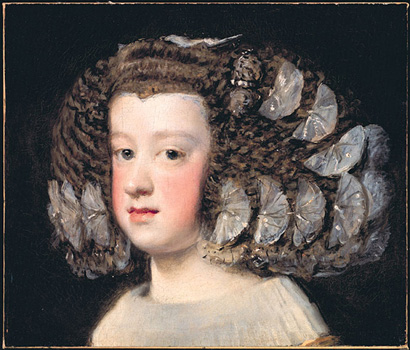
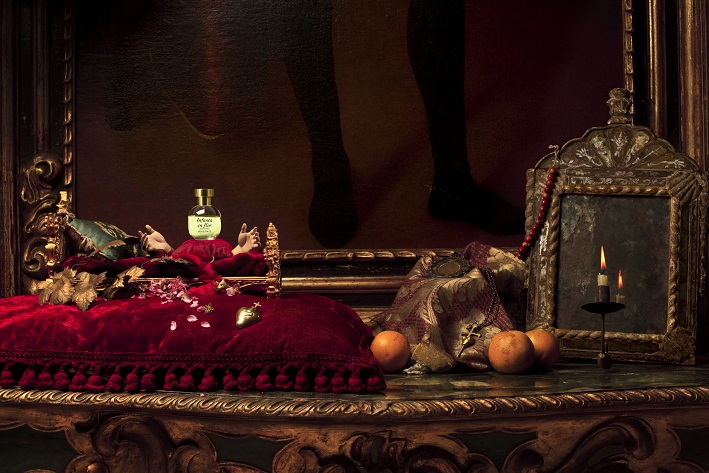
Infanta en Flor fue inspirado por el encuentro, en 1660, de la Infanta Maria Teresa de España, a la sazón de 14 años, y su prometido, Luis XIV. El matrimonio, por supuesto, había sido arreglado y la muchacha, ofrecida a cambio de la paz entre España y Francia. La fragancia fue desarrollada por el nariz Yann Vasnier y, al igual que una niña-novia, no mostró todos sus encantos al mismo tiempo.

Infanta en Flor es inocente y sin embargo retiene un carácter íntimo. No encarna una  “inocencia inocente” sino una inocencia que está a punto de ser perdida. Esta niña pronto conocerá las cuestiones del mundo y las intrigas palaciegas. El perfume captura la expectación y los aromas que pintan la escena…la flor de naranjo que perfuma sus guantes (también simbólica de su condición de novia), el olor almizclado de la piel humana, el cuero de España  del abanico que lleva en su mano y con el que tímida (o quizás juguetonamente) se cubre la cara. Muchos años más tarde, cuando -madura y desencantada- ya no quede en ella nada de inocencia, probablemente huela a Bal a Versailles .

Infanta en Flor tiene longevidad y presencia sorprendentes para una fragancia tan suave.

Caro

Origen de la muestra: Muestra cortesía de Arquiste Parfumeur

foto: Gentileza de Arquiste         fotógrafo: Ilan Rabchinskey

Arquiste Infanta en Flor – Lost innocence

There was truly so much to be smelled and seen at Pitti Fragranze, I couldn’t  -unfortunately- sniff even half of it.

Arquiste,  the brand founded by Carlos Huber, was among those that impressed me the most. I knew the line had met a favorable reception when it was launched and that it had soon found a place at Roja Dove Haute Parfumerie, so I was expecting it to be good…but calling it “good” would be an understatement! The Arquiste fragrances surprised me with their originality and careful edition. They tell stories and make one travel in time, but they do not smell dated. I found them complex yet still lightweight. I inhaled: the fair had disappeared and I was immersed in a world that seemed both unknown and familiar.

I did not pay too much attention to it at first as I was in awe with the  baroque beauty of Anima Dulcis and the elegant luminosity of Fleur de Louis. Infanta en Flor promised to be just another tender white floral.  All I got was an orange blossom note that evoked baby cologne. For a second I wondered if this smelled somehow alike to the Agua de Colonia Sanborns, which Carlos Huber had mentioned in our former interview.

Infanta en Flor was inspired by the meeting, in 1660, of Infanta Maria Teresa of Spain, then 14, and her fiancé, Louis XIV. The marriage had, of course, been arranged and the young girl offered in exchange for peace between Spain and France. The fragrance was developed by nose Yann Vasnier and, much like a child bride, didn’t show all its charms at once.

Infanta en Flor is innocent, yet there’s an intimate character to it. It doesn’t embody “innocent-innocence” but innocence that is about to be lost. This girl will soon know the ways of the world and palace intrigues. The fragrance captures expectation and the aromas that paint the scene…the orange blossom that scents her gloves (also symbolic of her bridal status), the musky odor of human skin, the Spanish leather of the fan she carries in her hand and with which she timidly (or perhaps playfully) covers her face. Many years later, when -mature and disenchanted- no innocence remains on her at all, she will probably reek of Bal a Versailles .

Infanta en Flor has surprising longevity and presence for such a soft scent.

Caro

Origin of sample: Sample courtesy of Arquiste Parfumeur

Eau d’Italie Au Lac – Romance en el paraíso

foto: Foodloversodyssey.typepad.com

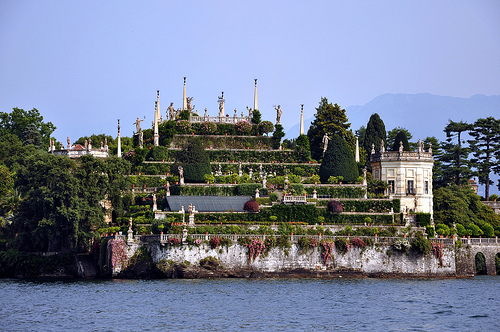
Las fragancias de Eau d’Italie nos regalan postales de paisajes característicos de la bella Italia, pero Au Lac (2010) nos cuenta también una historia de amor. Se trata del mismo romance que relata el libro de Marella Caracciolo Chia, “The Light in Between”. Sus protagonistas fueron la princesa Vittoria Colonna y el artista Umberto Boccioni. ¿El lugar? Una de las islas del Lago Maggiore.

Fue un affaire muy breve en el verano de 1916. Aunque su final estuvo sentenciado por la muerte accidental de Boccioni, su desarrollo fue idílico: en los jardines aterrazados en el medio de lago. Allí se funden el agua, el verde, las flores y el clima mediterráneo con las fuentes y las esculturas de estilo clásico.

El perfumista Alberto Morillas comienza Au Lac trazando una superficie de notas cristalinas con lirio de agua y naranja amarga. Un verde casi crocante de hojas de higuera ensambla con el femenino corazón de jazmín Sambac -de translúcidos destellos amielados-, osmanto y rosa. El romance culmina con un acorde cálido e intenso de cedroambar mineral y papiro.

A grandes rasgos, creo que hay una conexión con Cartier Baiser Volé, lanzado un año después que Au Lac. Siento, sin embargo, que este último es más inocente y melancólico.

Virginia

Origen de la muestra: gentileza de la marca.

Nota: la versión original de esta reseña fue publicada en el blog Notas & Acordes el 14/06/12.

foto: Eauditalie.com